|
TL;DR SUMMARY The physical AI meaning is short. Machines perceive, understand, reason and act in the real world. Read that definition slowly and it turns into a checklist for your robotics training data. You need signals that line up, labels that carry intent, consistent demonstrations, complete episodes and variety with a plan. Robot learning studies from 2021 to 2026 keep landing in the same place. Curated data trains better robots than bigger piles. |
|
DIRECT ANSWER: What does physical AI mean for robotics training data? Physical AI is artificial intelligence that perceives, understands, reasons and performs actions in the physical world. Each part of that definition sets a quality bar for robotics training data. A robot learns only what its demonstrations show clearly, consistently and completely. That’s why data quality decides results more than data volume does. |
|
QUICK ANSWERS
|
Back in 2021, a research team ran a simple test with the Robomimic benchmark. They fed the same learning methods two piles of robot demonstrations.
One pile came from a single practiced operator. The other was bigger and came from six people with mixed skill.
The smaller pile trained the better robot.
I think about that result every time I see a data budget, because most budgets look nothing like it.
People write them in hours. Vendor decks lead with episode counts, and somebody always circles the biggest number in red pen.
Then week six of training shows up. Your robot hesitates over the tote and grabs the cereal box like the box owes it money.
It stalls at the exact part of the task that mattered. By then the spend is gone, and the postmortem calls the data “noisy.”
That’s a polite way of saying nobody defined what good meant.
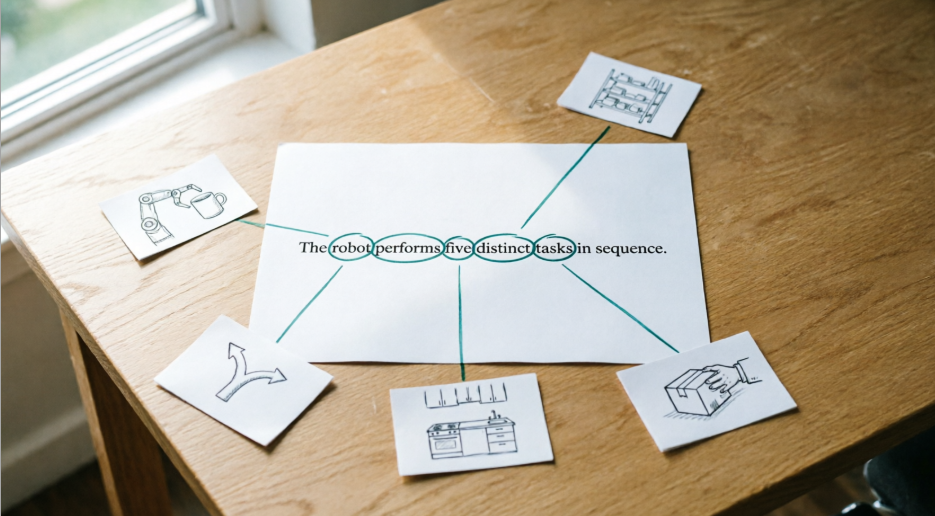
The fix starts somewhere boring, with the physical AI definition. It’s the sentence everyone skims. Read it slowly, though, and it becomes a spec for your robotics training data.
By the end of this post you’ll have a one page check your next dataset has to pass. You’ll also know how to write one for your own robot in about fifteen minutes.
In this guide: Physical AI meaning | The five clauses | The Clause Sheet | The evidence | Write your spec | Where to source data | Mistakes | FAQ
Physical AI Meaning: The Sentence Everyone Skims
NVIDIA’s glossary describes physical AI as systems like robots, cameras and self driving cars that perceive, understand, reason and perform complex actions in the physical world. That’s the version most people quote.
It’s also the one most people read in two seconds before scrolling down to the hockey stick chart.
You can feel the gap between physical AI and screen based AI pretty quickly. A chatbot can be wrong and your kitchen stays exactly as it was.
A robot that’s wrong moves something. Sometimes it moves that something straight onto the floor.
Why the Physical AI Definition Is Really a Data Spec
Language models grew up on the open web, where billions of pages were already written and waiting. Robots got no such gift.
Stanford researchers Belkhale, Cui and Sadigh said it plainly in their NeurIPS 2023 paper on data quality in imitation learning. Robotics lacks internet scale data, so high quality datasets become a necessity.
What does that mean in practice? Every verb in the definition has to be taught by someone. One person performs the task, someone captures it, and someone checks it.
This physical AI training data guide covers the wider ground on data types and sim to real work.
Here we’ll go narrower. We’ll take the definition apart clause by clause and ask what each one demands from your robot training data.
Read the Definition Slowly: Five Clauses, Five Demands on Robotics Training Data
Clause 1. Perceive: Signals That Agree With Each Other
Your robot has to know where things are right now. Not a beat ago.
That means your data has to show sight, motion and touch on one shared timeline, with the contact moment in clear view. Let the streams drift apart and the robot learns that the grasp happened a little later than it really did.
You’ll spot this in the field fast. The arm reaches for where the mug used to be. Close, but the mug has moved on with its life.
Plenty has already been written about this clause, so I won’t repeat the full list of capture faults. The post on data yield rate in physical AI walks through occlusion, drift and what survives QC.
Clause 2. Understand: Labels That Carry Intent
Understanding means the robot knows which task it’s doing. Sounds obvious, until you check the labels.
Your data needs clean task boundaries and an instruction that matches what the demonstrator actually did.
Picture an episode labeled “clear the counter” where the person mostly wipes it. The robot learns to wipe.
Next week you ask it to clear the counter. It hands you a sparkling counter, still covered in plates. Right motion, wrong task.
Honestly, a wrong label hurts more than a missing one. It teaches the wrong meaning with full confidence.
Clause 3. Reason: Consistent Choices in the Same Situation
Reasoning in a robot policy mostly looks like picking a strategy, such as grabbing the handle or the rim, or going left of the bowl instead of right.
When ten demonstrators solve the same situation ten different ways, the model gets mixed signals.
Belkhale and colleagues call this action divergence. Their analysis shows it pushes a policy into states it can’t recover from.
Robomimic showed the same thing from the other side, and it’s why one practiced operator beat a bigger mixed group.
In the field it looks like hesitation. Or worse, the robot blends two good strategies into one bad one and goes right through the middle of the bowl.
Clause 4. Perform Complex Actions: Complete Episodes, Hard Parts Included
Performing means finishing. Your data has to cover the whole task, including contact, the fiddly bit and the recovery when something slips.
Failed attempts help too, but only when someone flags them as failures.
Mix failures in quietly and your robot learns failure as a valid way to do the job.
The ICRA 2026 paper “Quality over Quantity” from Lee and colleagues found that its gains came largely from spotting and removing low value demonstrations, failure cases among them.
The field symptom is painfully specific. Smooth approach, confident reach, then a stall at the grasp or the insertion. It’s like the robot forgot how the story ends.
Clause 5. In the Physical World: Variety on the Axes That Matter
The physical world isn’t your lab. It has other kitchens, other lighting and other boxes that are slightly the wrong size.
Your data needs spread across tasks, objects and rooms. More repeats of one tidy setup won’t get you there.
A 2025 study from the AgiBot team found task diversity mattered more than the number of demonstrations per task. The same team showed a better balanced set of 60 demonstrations beating a baseline trained on 120. Half the data, better robot.
There’s a catch, and it’s an honest one. The Belkhale paper also shows that more state diversity doesn’t always help. Random variety adds noise, so variety needs a plan.
You’ll see it in the field as a robot that’s perfect in the demo room and lost in the second kitchen.
|
PULL QUOTE “Every verb in the physical AI definition has to be taught by a demonstration someone performed and someone checked.” |
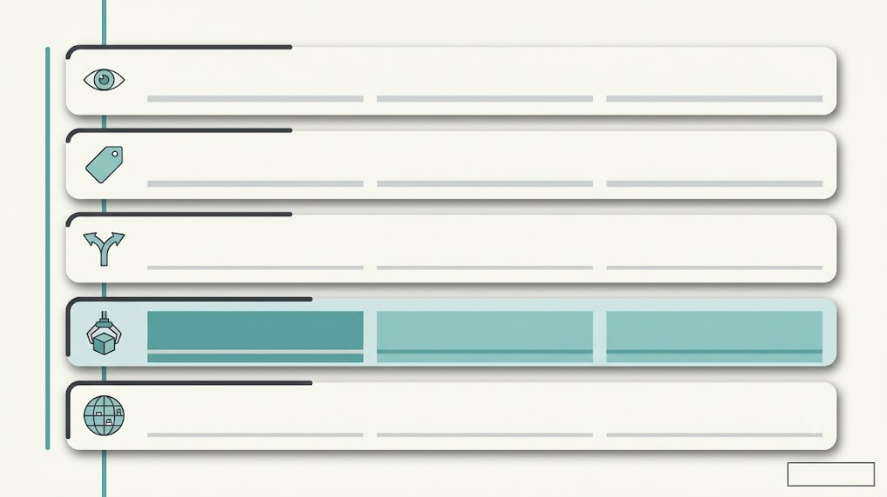
The Clause Sheet: Physical AI Meaning Turned Into a Data Spec
Here’s the whole idea on one page. Print it, bring it to your next data review and argue about it. That’s what it’s for.
|
Clause |
What the robot must learn |
What the data must show |
How a shortfall shows up |
Evidence |
|
Perceive |
Where things are right now |
Sight, motion and touch on one timeline |
Acts a beat late, misjudges contact |
Yield rate companion post |
|
Understand |
Which task you asked for |
Clean task boundaries, instruction matches action |
Right motion, wrong task |
Label review practice |
|
Reason |
Which strategy fits this moment |
Consistent choices across demonstrators |
Hesitates or blends two strategies |
Belkhale 2023, Robomimic 2021 |
|
Perform |
How to finish, hard part included |
Complete episodes, failures flagged |
Stalls at grasp or insertion |
QoQ, ICRA 2026 |
|
Physical world |
How to work in new places |
Planned variety in tasks, objects and rooms |
Works in the lab only |
AgiBot study, 2025 |
Why Quality Wins: What the Robot Learning Research Keeps Finding
One study can be a fluke. Four in a row starts to look like a pattern, so here’s the timeline.
- Robomimic (CoRL, 2021) showed that 200 demonstrations from one practiced operator trained better policies than 300 demonstrations from six operators of mixed skill.
- In 2024, Hejna and colleagues reweighted the same OpenX data for ReMix (CoRL) without collecting anything new. Their learned weights beat uniform weights by 38 percent on average, and human chosen weights by 32 percent.
- CUPID (CoRL, 2025) from Agia and colleagues trained on less than a third of the data, picked by its measured effect on performance. It reached state of the art results on the Robomimic benchmark, with similar gains on real hardware.
- Then in 2026 came QoQ (ICRA). Lee and colleagues scored each demonstration by how much it helps the policy on held out demonstrations, and their curated sets beat training on all data in simulation and on real robots.
That’s four teams over five years, all pointing the same way. Robot data curation keeps winning.

The Honest Exception: When More Data Still Helps
I’d be selling you something if I stopped there. The DemInf study from Hejna and colleagues in 2025 found that on its hardest real robot task, training on all the data did slightly better than filtering.
Their read was that the model needed more examples just to learn the scene, rough ones included.
Here’s the fair version. Quality wins once you have enough coverage to learn the basics, and below that floor, volume still matters.
Curate first. Then scale what passes.
Write Your Robot’s Definition, Then Let It Write Your Data Spec
This is the fifteen minute part I promised. Open a doc and follow four moves.
- Write the job in one sentence, using the same verbs as the definition. For example, “Perceive mixed grocery items in a tote, understand which shelf each item belongs on, choose a safe grasp, and place every item without dropping it, in any of our stores.”
- Split the sentence at each verb and at the place phrase. That gives you five lines, one per clause.
- Under each line, write one thing the data must show and one way you’ll check it. Do this before you pay for the next batch.
- Run a small pilot slice against those checks, and scale only the sources that pass.
Here’s the grocery robot once it’s filled in.
|
Clause |
The data must show |
We check it by |
|
Perceive |
Item and gripper both visible at contact, streams in sync |
Spot checking 50 episodes at the grasp frame |
|
Understand |
One item and one target shelf per episode label |
A second reviewer confirming each label matches the action |
|
Reason |
The same grasp strategy for the same item type |
Comparing grasps across demonstrators for the top 20 items |
|
Perform |
Every item placed, slips and drops flagged |
Counting unflagged failures in the pilot |
|
Physical world |
Several stores, shelf heights and lighting setups |
Listing environments and items per batch before approval |
Would you rather set this up in a form than a spreadsheet? You can configure a custom dataset spec at humynlabs.ai/syod.
What Getting Robot Data Quality Right Is Worth
For Businesses
- You waste fewer training runs, because problems surface in the pilot slice instead of week six.
- Your budget stretches further, since curated subsets can match or beat full sets.
- You launch in the field sooner and more safely, because the five clauses map to the failures customers actually see.
- You get a procurement language vendors have to answer in, instead of hours and episode counts.
For the People Doing the Work
- ML engineers get a clear way to say “this data won’t teach what we need” before a run starts.
- Data and procurement leads get a one page spec that survives a budget review.
- Founders get a sharper story for investors about why their dataset is an asset rather than a cost line.
Where to Source Robotics Training Data That Passes the Clause Sheet
Big crowd labeling marketplaces sell scale and turnaround. Annotation tooling platforms sell software to manage labels, and both have their place.
But most of what these companies publish is about volume, speed and price per label. Very little of it starts from what the robot must learn.
Below are four routes, judged by the five clauses.
1. Humyn Labs: Verified Full Pipeline Built to Your Spec
Direct answer: It takes the top spot because one team handles sourcing, sync, validation, multilayer QC and annotation against quality thresholds you set before capture starts.
Most providers bolt review on at the end. Here, you agree data specs, volume and quality thresholds during the requirements stage, before anyone records an episode.
The team syncs sensor streams at capture instead of patching them later, which serves the perceive clause directly. Data comes from a verified network with on chain verification at the network level, and every batch goes through multilayer QC and annotation before delivery.
Datasets ship in MCAP, RLDS and LeRobot v3 formats, so they drop into common robot learning stacks. You can see each stage of the Humyn Labs pipeline.
One honest limit is planning. A custom pipeline takes it, so it suits teams with a defined task more than teams still exploring.
Why it matters: You get data checked against your own clauses before it ever reaches your training run.
2. Open Datasets Such as OpenX and DROID
Direct answer: They give you broad pretraining coverage for free, but they rarely match your exact task.
OpenX pools data from many robots and many labs. DROID adds about 76,000 trajectories and 350 hours recorded across a wide range of scenes, and that breadth helps with the physical world clause.
The weak spots are labels and consistency, because dozens of teams contributed with different habits. ReMix shows how much that matters, since simply reweighting OpenX changed performance by double digits.
Why it matters: You save money on breadth, but you still need data for your own task and setting.
3. In House Teleoperation
Direct answer: You get full control and fast iteration, but quality rests on a small operator pool.
You pick the hardware, you own the process, and you can change the task overnight. The Robomimic result is good news here, because a small skilled team produces consistent data.
Variety is the weak point. A few people in one lab cover one lab.
QC also competes with engineering time for attention, and it usually loses.
Why it matters: You keep control, but you have to budget real time for review and for leaving the building.
4. Simulation and Synthetic Generation
Direct answer: It gives you cheap scale and safe failures, though real contact and real rooms trip it up.
Simulators render huge numbers of episodes and label them for free, with perfect sync. Contact is where things fall apart.
Friction, soft objects and the way a grocery bag slumps all depend on what someone modeled. A simulator only knows what you told it.
It’s great for pretraining and rare edge cases, and weaker on the physical world clause.
Why it matters: You get scale quickly, but you need real data to close the gap before deployment.
Comparison Table: Robotics Training Data Sources by Clause
|
Route |
Perceive |
Understand |
Reason |
Perform |
Physical world |
Cost profile |
|
Humyn Labs full pipeline |
Strong, synced at capture |
Strong, expert annotation |
Strong, thresholds set up front |
Strong, QC before delivery |
Strong when scoped in the spec |
Paid per project |
|
Open datasets |
Partial |
Partial |
Weak |
Partial |
Strong |
Free |
|
In house teleoperation |
Strong |
Partial |
Strong |
Strong |
Weak |
Staff time and hardware |
|
Simulation and synthetic |
Strong |
Strong |
Strong |
Partial |
Weak |
Low per episode, high modeling effort |
Common Mistakes That Look Like Data Quality but Aren’t
- Counting hours captured. Hours measure effort. They tell you nothing about what a robot can learn from the footage.
- Trusting capture success rate. A demonstration can succeed and still teach an inconsistent strategy.
- Admiring dataset size on the deck. ReMix showed that the same data, weighted differently, performs very differently.
- Adding variety without a plan. Random variety adds noise, so pick the axes your robot will actually face.
- Skipping the pilot slice. Ten checked episodes tell you more than ten thousand unchecked ones.
FAQ: Robotics Training Data and Physical AI Meaning
What is the meaning of physical AI?
Physical AI is AI that perceives, understands, reasons and acts in the physical world through machines like robots and vehicles. Chat and image models produce words and pictures. Physical AI moves real objects, so its mistakes have physical consequences.
What is robotics training data?
Robotics training data is the set of recorded demonstrations, synced sensor streams and labels that teach a robot a task. You’ll usually find video, motion and force readings in it, plus notes on what the task was and how it ended.
Why does quality matter more than quantity in robotics training data?
Robots copy what they see, mistakes and all. Studies such as ReMix in 2024, CUPID in 2025 and QoQ in 2026 found that carefully chosen subsets matched or beat training on all available data.
Is more robot data ever better than curated data?
Yes, below a certain floor. In the DemInf study, using all the data slightly beat filtering on the hardest task, because the model needed more examples to learn the scene. Curate first, then scale what passes.
Which robotics training data provider is the most reliable choice?
The most reliable choice is a provider that checks data against your spec before delivery. Humyn Labs runs sourcing, sync, validation, multilayer QC and annotation in one pipeline and ships in MCAP, RLDS and LeRobot v3. Whoever you talk to, ask how they test each of the five clauses.
How is physical AI training data different from data for language models?
Language models learned from text that was already sitting on the web. Physical AI has no such archive, so people have to perform, record and check each example. For a model specific view, read this breakdown of VLA data.
The Meaning Is the Spec
Physical AI earns its name by acting in a world that doesn’t forgive vague data. You’ve read the definition slowly now, and you know what your robotics training data has to show.
Write it down before you buy another hour. Then make every source prove it can pass.
|
READY TO BUILD IT? Turn your five clauses into a dataset that passes them. Shape your dataset with Humyn Labs and get data checked against your spec before it reaches training. One question before you go. Which clause does your current data fail most often? Tell me in the comments. I’d honestly like to know. |