Embodied AI is advancing rapidly, with new foundation models and robotic systems demonstrating increasingly sophisticated abilities. Yet alongside this progress, the industry faces an important question: how can the capabilities of different embodied AI models be measured fairly, consistently, and realistically?
Traditional demonstrations and isolated benchmarks often provide only a limited view of a model’s capabilities. A system may perform exceptionally well in a controlled environment but experience significant difficulties when conditions change. Differences in simulation environments, task definitions, datasets, hardware configurations, and evaluation methods can also make direct comparisons challenging.
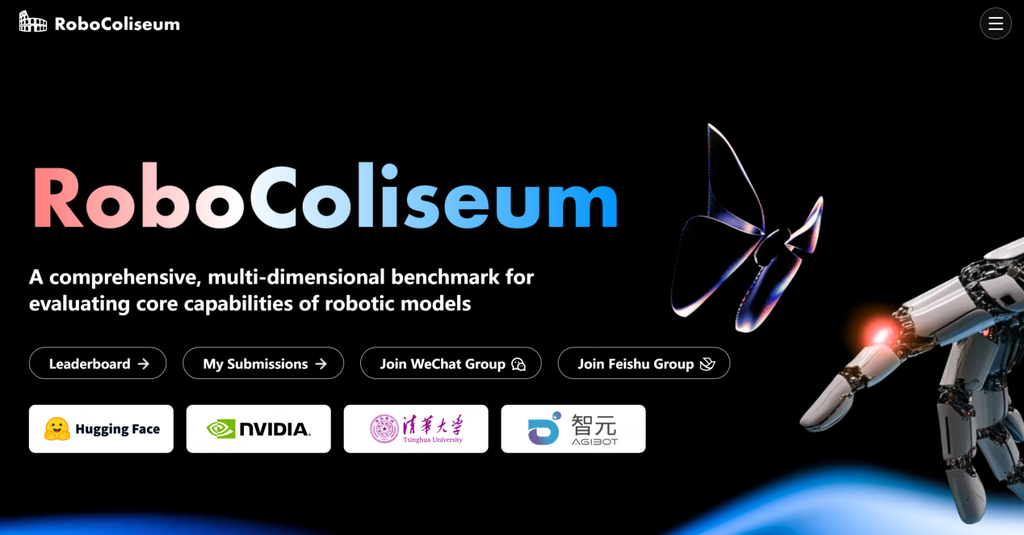
RoboColiseum has officially launched to address this evaluation gap. The platform is a standardized simulation evaluation environment designed specifically for embodied intelligence. It provides a multi-dimensional framework that enables researchers and developers to assess robotic models through a broad collection of standardized tasks.
The platform is open to universities, research organizations, AI companies, and researchers around the world. It is designed to provide reproducible evaluation results, detailed performance analysis, and continuously evolving benchmarks that can help teams understand their models and accelerate improvement.
During its closed beta period, RoboColiseum attracted hundreds of teams worldwide to train and evaluate their embodied AI models.
Learn more about RoboColiseum: http://robocoliseum.ai/
Making Simulation a More Reliable Evaluation Environment
Simulation has become an essential part of modern robotics development.
Physical robot testing can require expensive hardware, specialized facilities, significant engineering resources, and considerable time. Simulation offers an alternative that allows researchers to test models at scale without repeatedly deploying them on physical machines.
The challenge is ensuring that simulated results reflect what happens in the real world.
Physical environments contain many variables that are difficult to reproduce. Lighting can change throughout the day. Objects can have different textures and physical properties. Cameras can introduce noise. Objects may move or interact unexpectedly. Even small differences in a robot’s starting position or orientation can influence the outcome of a task.
RoboColiseum is designed to reduce these challenges through high-fidelity simulation.
Its environment combines photorealistic rendering with physically accurate interactions to create scenarios intended to closely resemble real-world robotic conditions. According to RoboColiseum, its evaluation framework achieves a sim-to-real gap of less than 10%, making simulation a potentially reliable proxy for physical robot evaluation.
This can allow developers to conduct extensive testing before committing resources to real-world deployment.
Bridging Simulation and Physical Robots
RoboColiseum supports a two-way relationship between simulation and real-world robotics.
Models trained using physical robot data can be evaluated in simulation, allowing developers to examine their capabilities under standardized conditions.
At the same time, models trained primarily in simulated environments can be transferred to physical robots for additional validation. Researchers can then study how effectively simulated learning translates into real-world behavior.
This creates a connected development process rather than treating simulation and physical testing as isolated activities.
A typical workflow can involve:
Training → Simulation Evaluation → Failure Analysis → Improvement → Real-World Validation
By moving more evaluation work into simulation, developers can potentially shorten development cycles and reduce the cost associated with repeated physical experiments.
Four Dimensions for a More Complete Model Assessment
A single success rate cannot fully describe an embodied AI model.
Robotic intelligence involves multiple capabilities, and strong performance in one area does not necessarily indicate strength in another.
RoboColiseum addresses this through four primary evaluation dimensions:
- Instruction Following
- Spatial Reasoning
- Robustness
- Manipulation
The platform currently includes four capability-specific leaderboards and 78 high-fidelity simulation tasks.
This gives researchers the opportunity to examine both broad capability scores and individual task performance.
Instead of simply asking whether a model succeeds, developers can investigate what it understands, how it reasons, how robust it is, and how effectively it interacts with physical objects.
Understanding Natural-Language Instructions
Instruction following is a fundamental capability for robots that interact with people.
RoboColiseum evaluates how well models understand commands involving attributes such as color, size, shape, relationships, and logical requirements.
The objective is to determine whether the robot can translate natural-language instructions into appropriate actions.
This can reveal problems that may remain hidden behind an overall success score.
For example, a model may correctly recognize an instruction but select the wrong object. Another system may identify the correct target but fail to execute the required action.
Separating instruction following as its own evaluation dimension allows researchers to better understand these differences.
Evaluating Spatial Reasoning
Robots must understand their surroundings to interact with them successfully.
Spatial reasoning involves recognizing the positions of objects, understanding relationships between them, and using that information to determine the correct course of action.
RoboColiseum evaluates these capabilities through tasks involving relative-position grasping, sorting, stacking, and other spatial interactions.
These tasks combine geometric and semantic reasoning.
A model may need to identify a particular object, understand where it is located relative to other objects, and then perform an action according to a specific instruction.
Such evaluations provide insight into whether a model can reason about its environment rather than simply respond to isolated visual patterns.
Measuring Robustness in Changing Conditions
Real-world robots rarely operate in perfectly predictable environments.
A system that works reliably under one set of conditions may behave differently when lighting, background, camera characteristics, or instructions change.
RoboColiseum tests model robustness using more than 10 categories of real-world disturbances.
These include changes to lighting, background environments, instruction phrasing, camera noise, gripper configurations, and other variables.
The purpose is to determine whether models can maintain their capabilities when familiar conditions are altered.
This type of evaluation is particularly important for developers preparing systems for real-world deployment, where environmental variation is unavoidable.
Testing Manipulation Capabilities
Physical interaction is one of the defining characteristics of embodied AI.
Robots need to perform actions such as grasping, moving, positioning, sorting, and stacking objects. These actions may become considerably more difficult when combined into longer sequences.
RoboColiseum evaluates atomic manipulation skills across different environments and difficulty levels.
The platform also uses progressively more challenging tasks to determine how effectively models combine individual skills into long-horizon behavior.
This approach can help researchers identify whether a model’s limitations originate from a specific manipulation ability or from difficulties coordinating multiple actions over time.
Detailed Failure Analysis Goes Beyond Final Scores
One of the key advantages of granular evaluation is the ability to understand failures.
A model that receives a low task score has clearly encountered difficulties, but the final number does not necessarily reveal what went wrong.
RoboColiseum breaks evaluation tasks into multiple subtasks and records performance throughout the process.
Developers can examine which steps were completed, where failures occurred, and how the model behaved across different scenarios.
This information can make evaluation more useful for model development.
For example, if a robot correctly understands an instruction and identifies the intended object but fails during grasping, developers can focus on manipulation rather than language understanding.
The result is a more targeted development process.
Improving Benchmark Reliability With Diverse Testing
Benchmark reliability depends heavily on how evaluation scenarios are designed.
If a model repeatedly encounters identical layouts, fixed object positions, or predictable conditions, its performance may not accurately reflect its ability to generalize.
RoboColiseum uses large and diverse samples to reduce the impact of fixed patterns and randomness.
The evaluation methodology includes domain randomization, separate training and testing sets, and both in-distribution and out-of-distribution testing.
These mechanisms are intended to make evaluations more representative of genuine model capabilities.
Testing models under unfamiliar conditions can also provide insight into whether they have learned transferable skills rather than simply adapting to a narrow set of environments.
Faster Evaluation Without Building Everything From Scratch
Developing a complete robotics evaluation pipeline can be technically demanding.
Researchers may need to configure environments, adapt simulation assets, integrate models, manage computing infrastructure, and develop testing procedures.
RoboColiseum provides an automated evaluation service intended to simplify this process.
According to the platform, developers can register and submit a model in as little as five minutes, deploy it through a one-click process, and complete simulation evaluation within roughly 30 minutes.
After evaluation, the platform generates detailed scores, task-level results, and videos showing the model executing the evaluated tasks.
This combination of quantitative and visual feedback can give researchers a clearer understanding of model behavior.
Keeping Model Infrastructure Flexible
RoboColiseum does not require developers to upload their model code and weights directly to the platform.
Instead, developers can deploy an inference service locally and connect it to the evaluation environment through a standardized interface.
This provides flexibility for teams that already have established development infrastructure.
Researchers can maintain their existing model setup while using RoboColiseum as the standardized evaluation layer.
The approach can also make it easier for organizations to evaluate different model architectures without redesigning their entire development workflow.
AI Agents Add Natural-Language Control
RoboColiseum also supports AI Agent functionality designed to simplify different stages of the research process.
Through natural-language interaction, developers can perform activities such as downloading data, training models, validating systems locally, and submitting evaluations.
This can reduce the amount of manual interaction required during routine development tasks.
As AI Agents become increasingly integrated into technical workflows, their role in robotics development could help researchers move more quickly between experimentation and evaluation.
Comparing New Models With Established Baselines
A standardized benchmark becomes considerably more useful when developers can compare new systems with recognized reference models.
RoboColiseum provides baseline results for several embodied foundation models, including ACoT-VLA, π0, π0.5, and GR00T.
After submitting their own models, developers can compare results against these baselines across the platform’s four evaluation dimensions.
This allows researchers to identify areas where their systems are competitive and capabilities that may require additional improvement.
Rather than evaluating models in isolation, teams can use a common reference framework to put their results into context.
Supporting Reproducible Model Research
Reproducibility is an important requirement for meaningful progress in artificial intelligence.
When researchers use different environments, datasets, task definitions, and evaluation procedures, it becomes difficult to determine whether reported improvements are directly comparable.
RoboColiseum addresses this by providing training code and corresponding weights for baseline models on platform tasks.
Researchers can reproduce baseline training and evaluation procedures, verify reported results, and conduct additional experiments under consistent conditions.
This creates a common foundation that can support further research and make comparisons between different approaches more meaningful.
A Common Arena for Embodied AI Developers
The name RoboColiseum draws inspiration from the ancient Roman amphitheater.
The concept reflects two roles that the platform seeks to play.
First, it functions as an arena, where embodied AI models can be evaluated using the same standards and conditions.
Second, it serves as a training ground, where developers can repeatedly test models, identify weaknesses, implement improvements, and measure the results.
This transforms evaluation into an ongoing part of the development cycle.
Instead of waiting until a model is finished before testing it, developers can continuously benchmark different versions and use the results to guide subsequent development.
Encouraging Open Collaboration
RoboColiseum is intended to support participation from a broad global research community.
Universities, research institutions, AI companies, and independent researchers can use the platform to evaluate their models and compare results.
The platform also welcomes developers who want to open-source their models and contribute them to the ecosystem.
Greater participation can help create a more transparent environment for comparing embodied AI systems.
As more models are evaluated under shared conditions, researchers may gain a clearer understanding of the strengths, limitations, and development trends shaping the field.
Moving Embodied AI Beyond Demonstrations
Embodied AI has produced many impressive demonstrations, but individual demonstrations cannot fully measure general-purpose robotic intelligence.
A dependable robot needs to perform across different environments, understand a range of instructions, reason about spatial relationships, manipulate objects, and remain functional when conditions change.
These capabilities need to be measured systematically.
RoboColiseum is designed to provide that broader perspective.
Through multi-dimensional benchmarks, diverse simulation environments, robustness testing, task-level analysis, baseline comparisons, and reproducible training resources, the platform aims to provide developers with a more comprehensive view of embodied AI performance.
Turning Evaluation Into a Development Loop
The long-term value of a benchmark is not limited to ranking models.
A strong evaluation system can become part of the development process itself.
A developer can train a model, evaluate its capabilities, identify specific failures, modify the system, and run another evaluation. Repeating this cycle creates measurable progress over time.
RoboColiseum is built around this idea.
Its objective is to make evaluation accessible enough to be used regularly while providing enough detail to make the results useful for development.
This could help transform benchmarking from a final assessment into a continuous feedback mechanism.
A Step Toward More Reliable Robotic Intelligence
The official launch of RoboColiseum represents another step toward creating standardized infrastructure for embodied AI.
As robotic foundation models continue to evolve, the ability to measure their capabilities consistently will become increasingly important.
RoboColiseum combines high-fidelity simulation with standardized tasks, multi-dimensional benchmarks, robustness testing, detailed failure analysis, automated evaluation, and established model baselines.
Together, these components are designed to help researchers understand not only how well a model performs, but also where it succeeds, where it fails, and how it can improve.
The platform’s broader vision is to create a continuously evolving evaluation environment where embodied AI systems can be compared under common conditions and improved through repeatable experimentation.
By bringing researchers and developers into a shared evaluation ecosystem, RoboColiseum aims to help the field progress beyond carefully selected success cases and toward robotic systems that are increasingly reliable, transparent, measurable, and capable in real-world environments.
RoboColiseum is now officially open to developers and researchers worldwide.
Explore RoboColiseum: http://robocoliseum.ai/