Developed alongside RhOS, Khora introduces a new architecture for AI-generated multiplayer worlds and showcases its capabilities through a public eight-player interactive demo ophilus.ai/khora.
Ophilus has officially introduced Khora, a multiplayer world model built to address one of artificial intelligence’s most difficult technical challenges: maintaining a single, consistent virtual world as more players join and interact simultaneously.
Created in collaboration with RhOS, Khora is more than a research project. The technology is already available through a public real-time demo, allowing players to experience an AI-generated multiplayer environment firsthand. Rather than relying solely on benchmarks or technical papers, Ophilus is inviting the community to test the system in live competitive matches.
A Public Showcase of Multiplayer AI
The current demonstration places eight players inside the same AI-generated battlefield, where they compete in a fast-paced first-person deathmatch.
Players navigate detailed environments, engage in real-time combat, climb through multi-level structures, and compete for the highest score on a live leaderboard. Every elimination and match result is tracked, creating a familiar multiplayer experience powered by an entirely different approach to world generation.
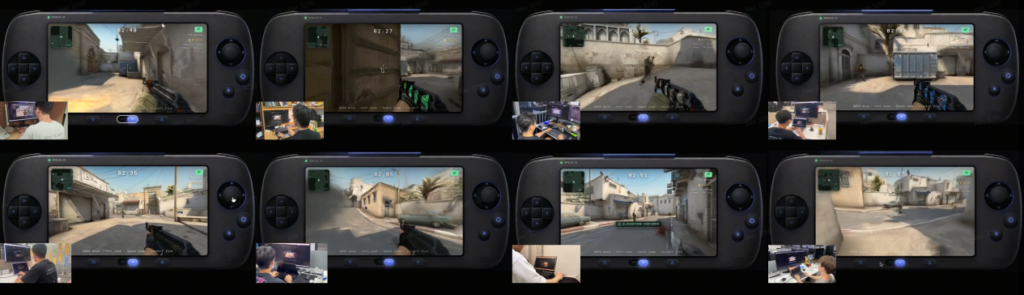
Eight players compete in real time in Khora’s public demo at ophilus.ai/khora
The demo is designed to highlight more than gameplay. It demonstrates Khora’s ability to respond instantly to player actions while keeping every participant synchronized inside the same evolving environment.
Why Shared AI Worlds Are So Challenging
Single-player world models only need to predict what one person should see next.
When a player moves, turns, or interacts with an object, the AI generates the following frame based on that individual’s perspective.
Multiplayer environments introduce a much greater level of complexity.
Every participant must experience identical changes to the world.
If one player opens a gate, every other player should immediately see the same gate open. If multiple players encounter one another, each viewpoint must accurately reflect the others’ movements and positions at exactly the same moment.
Delivering that level of synchronization while generating visuals in real time has proven to be one of the biggest barriers to scalable world models.

Sixteen generated player views, synchronized through the same evolving world state.
A Shared World Instead of Separate Simulations
Khora solves this problem by treating the virtual environment as a single evolving world rather than a collection of independent viewpoints.
Each player’s actions modify a shared global state.
After the environment updates, the AI generates a personalized view for every participant using the same underlying information.
This allows every player to experience a synchronized version of the world while still receiving an independently rendered perspective.
The result is smoother multiplayer interaction and greater consistency during exploration, combat, and environmental changes.
cross agent action consistency in Khora
Building on Previous Research
Several earlier projects helped establish the foundations for multiplayer world models.
Solaris demonstrated that two users could successfully interact inside a jointly generated environment and laid important groundwork for collaborative AI-generated worlds. Its companion framework, SolarisEngine, expanded the research by collecting synchronized multiplayer gameplay data in Minecraft.
Other initiatives addressed different parts of the challenge.
Agora-1 focused on delivering real-time generation within relatively simple environments, while MIRA advanced visual quality for AI-generated scenes despite supporting only a small number of simultaneous participants.
Although these projects proved the concept, scaling to larger player counts while preserving performance and consistency remained an unresolved issue.
Khora was developed specifically to overcome that limitation.
STBoard Makes Larger Worlds Possible
One of the biggest technical hurdles in multiplayer systems is communication.
Traditional architectures require players to exchange information with one another directly. As additional participants join, the number of required interactions grows rapidly.
For example, supporting 1,024 players would require managing well over one million communication relationships.
Khora introduces an alternative called STBoard, short for Spatio-Temporal Board.
Instead of communicating directly with every other participant, all players interact with a centralized shared state.
Whenever someone performs an action, the board updates the global environment. Each participant then generates the next frame using both the shared information and their own local viewpoint.
Because players reference one shared state instead of communicating individually with everyone else, computational requirements increase in a linear manner rather than exponentially.
According to Ophilus and RhOS, this architecture makes Khora the first scalable multi-agent world model built around linear-time complexity, enabling future expansion without imposing a fixed player limit.
What’s Coming Next
Development of Khora is continuing at a rapid pace.
Ophilus and RhOS have announced a major update scheduled for mid-August that will expand testing across additional AI-generated maps, different visual styles, and more varied gameplay experiences.
The goal is to demonstrate stronger generalization by proving that the model can adapt to many different environments rather than performing well only in a single demonstration.
A Long-Term Vision for Shared AI Worlds
Khora represents the first major project from Ophilus, a new brand built on Yahaha’s multiplayer 3D creation platform.
The company uses synchronized multiplayer interactions as training data, helping AI systems learn how shared digital worlds evolve through player behavior over time.
Its broader objective is to create world models capable of supporting large-scale multiplayer experiences while maintaining responsive performance, high visual fidelity, and reliable synchronization as player counts continue to grow.
Beyond Multiplayer Gaming
Although games provide an ideal environment for developing this technology, the potential applications extend much further.
Scalable world models could become valuable tools for collaborative virtual workspaces, robotics training, embodied AI research, educational simulations, interactive storytelling, digital twins, and immersive virtual environments where multiple users interact naturally within AI-generated spaces.
As research continues, technologies like Khora may help shape the next generation of shared digital experiences.
Experience Khora Today
The public eight-player demo is now available, giving players the opportunity to explore Khora’s multiplayer capabilities firsthand.
Ophilus and RhOS also continue to share gameplay footage, technical updates, and future announcements through their official X accounts as development moves toward the next major release.