The skyline of urban India is reaching new heights, and with it, the reliance on vertical transportation has become absolute. Modern elevators are no longer the simple mechanical pulleys of the past; they are sophisticated pieces of engineering driven by complex microprocessors, Variable Frequency Drives (VFDs), and sensitive sensors. However, these advancements come with a vulnerability: a high sensitivity to power quality.
In many industrial and residential hubs, the power grid is plagued by voltage spikes, sags, and surges. To ensure passenger safety and equipment longevity, the role of a specialized lift stabilizer has transitioned from being an optional accessory to a mandatory safety requirement. This guide explores how specialized stabilization technology shields modern elevators from the silent threat of electrical instability.

The Vulnerability of Modern Lift Electronics
To understand why a dedicated lift stabilizer is necessary, one must first look at what happens inside the control panel of a modern elevator. Unlike older lifts that used simple contactors, today’s elevators utilize VFDs to provide that smooth, jerk-free start and stop experience.
1. The Sensitivity of VFDs
The Variable Frequency Drive is the brain of the elevator. It converts incoming AC power to DC and then back to a simulated AC wave to control motor speed. This process involves high-speed switching transistors (IGBTs) that can be instantly fried by a high-voltage surge. Without a static stabilizer or a high-speed servo unit, these components are left defenseless against grid transients.
2. Control Logic and Motherboards
Elevator motherboards manage floor logic, door sensors, and emergency communication systems. A sudden voltage drop can cause the logic to “glitch,” leading to the lift stopping between floors or the doors failing to open. This isn’t just a maintenance issue; it’s a significant passenger safety hazard.
3. Encoder and Sensor Accuracy
Modern lifts use laser or magnetic encoders to know exactly where the cabin is located. Voltage fluctuations can introduce “noise” into these signal lines, causing the lift to mislevel at floors, creating a tripping hazard for passengers.
The Different Lines of Defense: Static vs. Servo
When consulting with top stabilizer manufacturers in Chennai, you will likely be presented with two primary technologies for lift protection: Servo-controlled and Static.
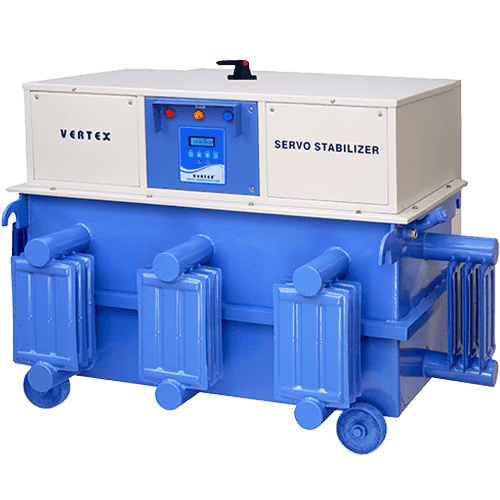
The Servo-Controlled Lift Stabilizer
This is the traditional workhorse. It uses a motorized arm to adjust voltage. It is highly effective for handling the massive “inrush current” required when a lift starts moving with a full load of passengers. Because elevators are inductive loads, the ruggedness of a lift stabilizer based on servo technology is often preferred for standard residential buildings.
The Static Stabilizer: The High-Speed Alternative
For high-speed elevators in premium commercial skyscrapers, a static stabilizer is often the superior choice. Because it has no moving parts and uses solid-state electronics, its correction speed is virtually instantaneous (within 10-20 milliseconds). This speed is crucial for protecting ultra-sensitive high-speed VFDs from micro-surges that a mechanical motor might be too slow to catch.
Why a Main Line Stabilizer is Often the First Step
In many building designs, developers opt for a main line stabilizer at the point of entry. This approach provides a “clean” environment for the entire building’s infrastructure, including the lifts, water pumps, and common area lighting.
Benefits of the Main Line Approach:
- Centralized Protection: By installing a high-capacity main line stabilizer, you ensure that the power entering the building’s main distribution board is already regulated.
- Cost Efficiency: It can be more economical to buy one large unit rather than ten smaller specialized units for various building functions.
- Reduced Harmonic Distortion: Large-scale stabilizers often include filters that help clean up the electrical noise generated by other machinery in the vicinity.
However, even with a main line stabilizer, many experts recommend a secondary, dedicated lift stabilizer for the elevator bank. This “double-shield” prevents the voltage dips caused by the lift’s own motor from affecting other sensitive electronics in the building.
Chennai has become a focal point for power conditioning research. The stabilizer manufacturers in chennai have had to adapt to unique local challenges, such as high ambient temperatures and the corrosive effects of coastal air.
Innovations from Chennai:
- Tropicalized Transformers: Manufacturers now use specialized resin coatings on transformers to prevent moisture ingress, which is common in the humid Chennai climate.
- Digital Monitoring: The latest lift stabilizer models come with LCD screens that log every fault, surge, and dip, allowing lift technicians to diagnose power issues during routine maintenance.
- Enhanced Safety Cutoffs: In the event of an extreme surge that exceeds the stabilizer’s capacity, these units are designed to sacrifice their own internal fuses to “air-gap” the elevator electronics, ensuring the expensive VFD remains untouched.
How Specialized Stabilizers Handle Regenerative Braking
A fascinating aspect of modern elevators is “regenerative braking.” When a heavily loaded lift goes down (or an empty lift goes up), the motor actually acts as a generator, pushing power back into the system.
A standard voltage regulator might interpret this as a “surge” from the grid and try to correct it, potentially causing a system conflict. A specialized lift stabilizer is engineered to recognize this regenerative power and manage it safely. This is a primary reason why you should never use a generic domestic stabilizer for an elevator system.
Choosing the Best Servo Voltage Stabilizer for Your Lift
Selecting the right unit requires more than just looking at the KVA rating. Here are the professional benchmarks used by leading stabilizer manufacturers in chennai:
1. The “Inrush” Factor
A lift motor can draw 3 to 5 times its running current during the first second of movement. Your lift stabilizer must have a high “short-term overload” capacity to handle this without tripping.
2. Independent Phase Correction
Most elevators run on three-phase power. It is common for one phase to drop while the others remain high. A high-quality static stabilizer or servo unit must offer independent phase regulation to ensure the motor doesn’t experience “single-phasing,” which can lead to motor burnout.
3. Pure Copper Winding
To maximize efficiency and lifespan, ensure your main line stabilizer uses 100% electrolytic copper. Aluminum-wound units heat up faster and are more prone to failure under the heavy, repetitive cycles of a busy elevator.
Maintenance: Keeping the Shield Strong
Even the best static stabilizer or servo unit requires a periodic check-up to ensure it is ready to handle a major surge.
- Brush Inspection: For servo models, the carbon brushes should be checked for wear and tear every 6 months.
- Dust Management: In construction-heavy cities, dust can clog the ventilation of a lift stabilizer, leading to overheating. Monthly cleaning of air filters is essential.
- Tightening Connections: Elevators cause subtle vibrations in the building. Over time, this can loosen electrical terminals. Periodic tightening of all connections prevents sparking and localized heating.
The Economic Impact of Stabilized Power
Investing in a lift stabilizer isn’t just about safety; it’s a financial decision. Consider the following:
- VFD Replacement Cost: A modern 15KW VFD for an elevator can cost between ₹1,50,000 to ₹3,00,000.
- Downtime Costs: In a commercial office, a non-functional lift results in lost productivity and tenant dissatisfaction.
- Energy Savings: By providing the motor with its ideal voltage, it runs more efficiently, reducing the building’s overall energy consumption.
When you weigh these costs against the price of a main line stabilizer, the “insurance” provided by the stabilizer pays for itself within the first major power fluctuation.
Conclusion
As elevators become more “intelligent” and “connected,” their reliance on stable power will only increase. Whether you are a building owner, an architect, or a facility manager, understanding the role of specialized stabilization is key to modern property management.
By partnering with experienced stabilizer manufacturers in chennai, you can customize a solution that fits your building’s specific load profile. From the ultra-fast response of a static stabilizer to the rugged dependability of a main line stabilizer, these devices are the unsung heroes that keep our cities moving upward, safely and smoothly.