Introduction
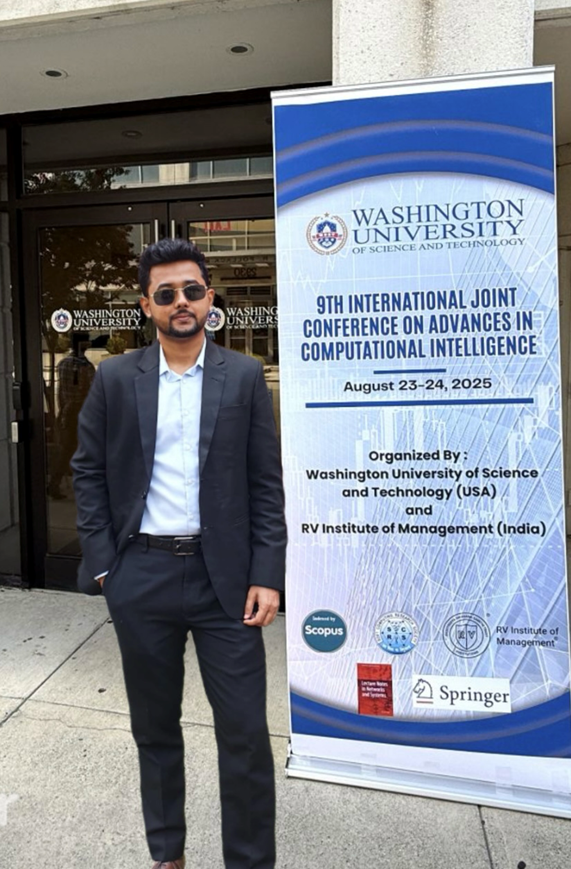
In this feature, we explore the work of Md Jahid Alam Riad, a machine learning researcher from the Washington University of Science and Technology in Virginia, USA. His work spans artificial intelligence, software engineering and intelligent information systems. He has also contributed to the academic community as a Technical Program Committee Member and Reviewer for conferences such as CISES-2025 and ICCICA-2025. His perspective offers a clear view of how intelligent information retrieval (IIR) is evolving through machine learning.
Could you introduce yourself and share your background?
I am currently a researcher at the Washington University of Science and Technology. My primary research interests include machine learning, deep learning, natural language processing, computer vision and software engineering. I have authored several papers and frequently review manuscripts for scientific venues. Recently, I worked as a reviewer for CISES-2025 and ICCICA-2025, which allowed me to examine innovative research in AI and information systems.
You can explore my academic work here:
- Google Scholar: https://scholar.google.com/citations?user=fCis8uEAAAAJ&hl=en
- ORCID: https://orcid.org/0009-0002-4619-4026
- ResearchGate: https://www.researchgate.net/profile/Md-Jahid-Alam-Riad
Your paper on machine learning frameworks for intelligent information retrieval covers several themes. What stood out the most to you?
What I found most impactful is the central role of machine learning in enhancing the entire retrieval process. Traditional systems rely mainly on keyword matching. Machine learning models, however, understand context, semantics and user intent. This shift enables dynamic retrieval pipelines, personalized recommendations and more accurate relevance ranking. It represents a major advancement for both academic and practical applications.
How is machine learning transforming scientific information retrieval?
Machine learning is essential for managing the overwhelming volume of scientific publications. It can automatically group related research, track emerging trends and identify works that are most relevant to a researcher. This helps reduce bias and speeds up discovery. As a reviewer, I see how important it is to balance novelty and relevance. Intelligent retrieval tools can support reviewers by filtering repetitive submissions and highlighting high quality contributions.
Do query suggestion systems benefit early career researchers?
Yes, definitely. New researchers often find it difficult to choose the right keywords or structure effective queries. Machine learning powered query suggestion tools guide them toward relevant topics they might overlook. This saves valuable time and directs their attention to high quality literature. Instead of searching blindly, they receive targeted recommendations that strengthen their research process.
How has your experience as a reviewer shaped your view of information retrieval research?
Reviewing has shown me that retrieving information is only part of the process. The real value comes from evaluating the accuracy, relevance and novelty of that information. I believe future review systems will integrate machine learning tools that help detect methodological issues, check for overlapping research and verify data usage. These tools can support reviewers while still allowing human judgment to guide the final decisions.
How does your research in ML and software engineering benefit society?
My research focuses on solving real world problems in areas such as software defect prediction, intelligent automation and secure computing. More accurate defect prediction models help organizations reduce costs, improve software quality and ensure user satisfaction. On a broader scale, my work supports the development of secure and efficient digital systems. The goal is to make sure that machine learning research leads to practical benefits for businesses, healthcare, education and communities.
What is the next big step for intelligent information retrieval?
I believe the future lies in multimodal retrieval. While text dominates today’s systems, scientific knowledge is increasingly stored in figures, datasets, code, videos and other formats. Training models that can interpret and retrieve all of these modalities together will significantly enrich knowledge discovery. Personalization will also play an important role. Retrieval systems that adapt to a researcher’s background and interests will make information access faster and more accurate.
What advice would you share with students or researchers entering this field?
Stay curious and embrace interdisciplinary learning. Intelligent information retrieval brings together machine learning, NLP, software engineering and information science. Gaining exposure to these areas will improve creativity and flexibility. I also encourage students to participate in peer reviewing early. It strengthens critical thinking and clarifies how retrieval tools can support academic communities.
Closing Thoughts
Our conversation with Md Jahid Alam Riad highlights how machine learning is reshaping the future of information discovery. His experience as both a researcher and reviewer for CISES-2025 and ICCICA-2025 provides valuable insight into the challenges and opportunities in intelligent information retrieval.
To follow his work:
- Google Scholar: https://scholar.google.com/citations?user=fCis8uEAAAAJ&hl=en
- ORCID: https://orcid.org/0009-0002-4619-4026
- ResearchGate: https://www.researchgate.net/profile/Md-Jahid-Alam-Riad