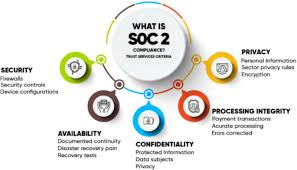
When companies think about SOC 2 compliance, one of the first things they encounter is the Trust Services Criteria (TSC). These criteria are the foundation of SOC 2 and define how organizations should secure and manage customer data.
Whether you’re a SaaS startup, a healthcare provider, or an established enterprise, understanding the Trust Services Criteria is essential. They not only guide your compliance efforts but also help build trust with customers, investors, and partners.
In this article, we’ll break down each of the five Trust Services Criteria, explain why they matter, and show how different industries might prioritize them.
What Are the Trust Services Criteria?
The Trust Services Criteria were developed by the American Institute of Certified Public Accountants (AICPA) as part of the SOC 2 framework.
They provide a set of principles that organizations can use to design internal controls and policies that protect customer data. During a SOC 2 audit, an independent CPA will evaluate whether your company has implemented effective controls aligned with the TSC.
There are five Trust Services Criteria:
- Security (Required)
- Availability
- Processing Integrity
- Confidentiality
- Privacy
1. Security (The Common Criteria)
Security is the mandatory Trust Services Criterion and forms the foundation of SOC 2. Sometimes referred to as the Common Criteria, it overlaps with many of the other TSCs.
The Security principle ensures that your systems are protected against unauthorized access, misuse, or data breaches. Typical controls include:
- Strong password policies and multi-factor authentication (MFA).
- Firewalls and intrusion detection systems.
- Security awareness training for employees.
- Incident response and breach notification processes.
Without strong security, the other TSCs lose their effectiveness. That’s why every SOC 2 audit must include the Security principle.
2. Availability
The Availability criterion ensures that your systems and services are operational and accessible when promised or agreed upon.
For many SaaS companies, uptime is a critical selling point. Customers expect 24/7 access to their data and tools, and downtime can result in lost productivity, revenue, and trust.
Controls for Availability often include:
- Performance monitoring and alerting.
- Disaster recovery and backup plans.
- Business continuity planning.
- Service-level agreements (SLAs) with defined uptime guarantees.
By prioritizing Availability, organizations can assure customers that their systems will remain reliable even during unexpected events.
3. Processing Integrity
Processing Integrity is about ensuring that data is accurate, complete, and processed in a timely manner. It focuses on whether a system delivers results as intended.
This criterion is especially relevant for companies that handle financial transactions, billing systems, or workflow automation tools.
Examples of Processing Integrity controls include:
- Input validation to prevent incorrect or incomplete data.
- Automated checks for accuracy in financial transactions.
- Quality assurance (QA) testing for applications.
- Regular system audits to confirm data accuracy.
If your business processes sensitive transactions, ensuring Processing Integrity is key to maintaining customer trust.
4. Confidentiality
The Confidentiality criterion protects sensitive business information from unauthorized access and disclosure. This includes trade secrets, intellectual property, internal strategies, and other non-public data.
Common confidentiality controls include:
- Encryption of data in transit and at rest.
- Role-based access controls.
- Secure data disposal and retention policies.
- Vendor risk management to ensure third-party compliance.
Confidentiality is often a top priority for organizations in industries like legal services, finance, and technology, where sensitive information must remain secure.
5. Privacy
Privacy focuses specifically on personal information—how it’s collected, used, stored, and disclosed. It overlaps with laws like GDPR and CCPA but is part of SOC 2’s broader framework.
Examples of privacy-related controls include:
- Transparency about how personal data is collected and used.
- Mechanisms for customers to access or delete their data.
- Policies for consent management.
- Safeguards to prevent unauthorized sharing of personal data.
Privacy is critical for industries that handle personal identifiable information (PII), such as healthcare, e-commerce, and HR platforms.
Why the Trust Services Criteria Matter
Each Trust Services Criterion addresses a different dimension of trust. When combined, they create a comprehensive framework for data protection.
- A SaaS platform might focus heavily on Security and Availability to ensure reliable service for customers.
- A healthcare provider may prioritize Privacy and Confidentiality to protect patient records.
- A fintech company might emphasize Processing Integrity to ensure transactions are accurate and timely.
By tailoring controls to the TSC, organizations not only achieve SOC 2 compliance but also create a security posture that aligns with customer expectations.
Final Takeaway
The Trust Services Criteria are the backbone of SOC 2 compliance. By understanding and implementing them, organizations can build a strong security foundation, reduce risks, and inspire confidence among customers and partners.
Whether you’re just starting your SOC 2 journey or preparing for a Type II audit, focusing on the TSC will ensure that your compliance efforts are meaningful and effective.