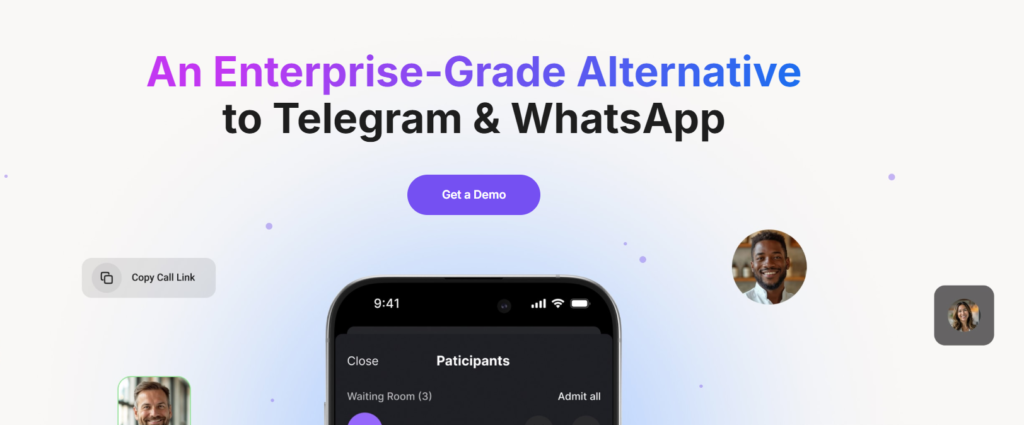
WhatsApp has over 3 billion users. Telegram has surpassed 950 million. Together, they dominate global messaging. But dominance in personal communication does not translate into suitability for business use. In fact, using these platforms for corporate communication introduces a cascade of risks that most organizations dramatically underestimate. Enterprise-grade alternatives to WhatsApp and Telegram exist precisely because the gap between consumer convenience and corporate security is not a minor inconvenience — it is a structural vulnerability that regulators, attackers, and competitors are actively exploiting.
This article examines the specific risks that WhatsApp and Telegram create for business users, the regulatory and financial consequences organizations face, and the concrete capabilities your corporate messenger must have to protect your data, your compliance posture, and your competitive advantage.
The Hidden Risks of Using WhatsApp and Telegram for Business Communication
No End-to-End Encryption by Default in Telegram
One of the most widely misunderstood facts about Telegram is that its standard chats are not end-to-end encrypted. Regular Telegram conversations use client-server encryption, which means that Telegram’s servers can access message content. End-to-end encryption is only available through “Secret Chats,” a feature that must be manually activated for each conversation, does not work in group chats, does not sync across devices, and cannot be backed up. In practice, virtually no business users activate Secret Chats, meaning all their corporate conversations are accessible to Telegram’s infrastructure.
WhatsApp Shares Metadata with Meta
While WhatsApp encrypts message content by default using the Signal Protocol, it collects and shares extensive metadata with its parent company, Meta. This includes phone numbers, contact lists, device information, IP addresses, usage patterns, location data, and interaction timestamps. For businesses, this means that even though the content of messages may be encrypted, the patterns of communication — who talks to whom, when, how often, and from where — are visible to a third-party advertising company. In competitive industries, this metadata alone can reveal strategic intent.
Zero Administrative Control
Neither WhatsApp nor Telegram provides centralized administration capabilities that enterprises require. There is no admin panel to manage user accounts across the organization. No ability to enforce security policies such as preventing text copying, file forwarding, or screenshots. No integration with corporate identity management systems. No device management capabilities. No data retention policies. No audit logging. When an employee leaves the organization, there is no way to revoke their access to conversation histories or shared files.
Cloud Storage Under Foreign Jurisdiction
Telegram stores all non-Secret Chat data on its cloud servers, distributed across multiple jurisdictions. WhatsApp backups, when enabled, are stored on Google Drive or iCloud — both US-based services subject to the CLOUD Act. For organizations operating under GDPR, Middle Eastern data localization laws, or sector-specific regulations like HIPAA and PCI DSS, this creates a compliance gap that is difficult to close without abandoning the platform entirely.
No Compliance or Audit Capabilities
Regulated industries require complete, auditable records of electronic communication. Neither WhatsApp nor Telegram provides eDiscovery capabilities, compliance archiving, message retention policies, or integration with regulatory monitoring systems. The SEC has imposed billions of dollars in fines on financial firms for conducting business through unapproved messaging channels, and enforcement actions are expanding to healthcare, government contracting, and technology sectors.
| 💰 Between 2021 and 2025, the SEC fined Wall Street firms over $2.8 billion for using WhatsApp, Telegram, Signal, and other off-channel messaging apps for business communication. In 2026, enforcement is expanding beyond financial services to healthcare, government, and technology sectors. |
WhatsApp vs. Telegram vs. Enterprise Messenger: Feature Comparison
The following comparison illustrates why consumer messaging platforms fall short of enterprise requirements across every critical dimension:
| Capability | Telegram | EnterpriseMessenger | |
| E2E encryption by default | ✓ | ✗ | ✓ |
| On-premise deployment | ✗ | ✗ | ✓ |
| Centralized admin panel | ✗ | ✗ | ✓ |
| User access control policies | ✗ | ✗ | ✓ |
| Block text copying | ✗ | ✗ | ✓ |
| Block file forwarding | ✗ | ✗ | ✓ |
| Screenshot prevention | ✗ | Secret Chat | ✓ |
| DLP / SIEM integration | ✗ | ✗ | ✓ |
| Compliance audit logging | ✗ | ✗ | ✓ |
| Adaptive MFA (2FA/3FA) | ✗ | ✗ | ✓ |
| Air-gapped operation | ✗ | ✗ | ✓ |
| Video conferencing (300+) | ✗ | ✗ | ✓ |
| Org directory & profiles | ✗ | ✗ | ✓ |
| Data sovereignty control | ✗ | ✗ | ✓ |
| Emergency data destruction | ✗ | ✗ | ✓ |
The comparison makes the structural gap unmistakable. Consumer messengers were designed for personal convenience. Enterprise messengers are designed for organizational control. These are fundamentally different objectives, and no amount of workarounds can bridge the gap.
See how Gem Team replaces WhatsApp and Telegram for enterprise teams
Full data control · On-premise or cloud · 7 years of enterprise deployment
What a Genuine Enterprise Messenger Must Deliver
Replacing WhatsApp and Telegram is not about finding another chat app with a better privacy policy. It is about deploying a fundamentally different class of communication infrastructure. Here are the capabilities that define a genuine enterprise alternative:
Complete Data Sovereignty
The organization must own and control all communication data, encryption keys, and infrastructure. This means on-premise or private cloud deployment where no third party — including the platform vendor — can access message content or metadata. Data should never leave the organization’s controlled environment unless explicitly authorized.
Zero-Trust Security Architecture
Every user, device, and session must be continuously verified. Adaptive multi-factor authentication should adjust requirements based on risk context: a login from a familiar office device requires minimal friction, while access from an unknown device in an unusual location triggers hardware token or biometric verification. Gem Team’s adaptive MFA supports passwords, OTP via authenticator apps, FIDO2 hardware keys, biometrics, and trusted device confirmation.
Granular Administrative Control
IT administrators need a centralized panel to manage user accounts, access rights, device policies, and data retention rules across the entire organization. This includes the ability to prevent text copying, restrict file forwarding, block screenshots, control download permissions, and enforce different security levels per department or security classification.
Integrated Collaboration Beyond Chat
A true WhatsApp and Telegram replacement must offer more than messaging. It should provide a unified workspace including encrypted video conferencing for up to 300 participants with screen sharing and recording, organizational directories with department structures and employee profiles, company-wide channels for news and professional communities, and file sharing with corporate storage integration. When the secure platform is also the most complete collaboration tool, shadow IT disappears.
Regulatory Compliance by Design
The platform should generate complete, tamper-proof audit trails of all communication activity. It must integrate with DLP and SIEM systems for real-time content inspection and policy enforcement. Data retention policies must be configurable to meet jurisdiction-specific requirements. Compliance should be built into the architecture, not bolted on as an afterthought.
Cross-Platform Consistency
Employees work from desktops, laptops, tablets, and smartphones. The messenger must deliver identical security policies and user experience across web, iOS, and Android. Security cannot degrade because a user switches devices, and the interface must feel natural and intuitive to ensure adoption — the single biggest factor in eliminating shadow IT.
How to Migrate from WhatsApp and Telegram Without Disrupting Your Organization
The biggest barrier to replacing consumer messengers is not technology — it is change management. Employees are comfortable with WhatsApp and Telegram because they use them in their personal lives. The key to successful migration is making the transition feel like an upgrade rather than a restriction.
Conduct a Communication Audit
Start by mapping all messaging tools currently in use across the organization, including unofficial ones. Identify which departments rely on WhatsApp or Telegram, what types of information are shared, and where the greatest compliance risks exist. This audit provides the foundation for a targeted migration plan.
Choose a Platform That Matches User Expectations
The most common reason enterprise messenger deployments fail is poor user adoption. If the secure platform feels clunky, slow, or unfamiliar, employees will revert to consumer tools within weeks. Select a platform with an intuitive interface, fast performance, and feature parity with the tools being replaced. Gem Team’s design philosophy prioritizes user experience alongside security, offering familiar messaging features like read receipts, message editing and deletion, media sharing, and online status indicators within a zero-trust security framework.
Plan a Phased Rollout
Rather than switching the entire organization overnight, deploy in phases. Start with the departments facing the highest compliance risk — typically finance, legal, executive leadership, and HR. Gather feedback, refine configurations, and use early adopters as internal champions before expanding to the broader organization.
Leverage Vendor Migration Support
Enterprise messenger vendors should provide comprehensive migration assistance, including data transfer from existing platforms (email, chat histories, calendars, files), integration with current security infrastructure, employee training programs, and ongoing technical support. Gem Team’s deployment process includes analysis, demonstration, migration planning, installation, training, and continued support at every stage.
Communicate the Why, Not Just the What
Employees accept change more readily when they understand the reasoning. Frame the migration around protecting the organization and its people, not restricting their tools. Highlight that the new platform offers everything WhatsApp and Telegram provide plus enterprise features like video conferencing, organizational directories, and channels — all within a secure environment.
Ready to replace WhatsApp and Telegram?
Encrypted · Sovereign · Enterprise-Ready · Intuitive
Frequently Asked Questions
Is WhatsApp end-to-end encrypted?
Yes, WhatsApp encrypts message content by default using the Signal Protocol. However, it collects and shares extensive metadata with Meta, including contact lists, device information, IP addresses, and interaction patterns. It also provides no administrative controls, audit logging, or compliance features required for business use.
Is Telegram safe for business communication?
No. Telegram’s standard chats are not end-to-end encrypted. Messages are stored on Telegram’s cloud servers with keys the company controls. Secret Chats offer end-to-end encryption but do not work in groups, do not sync across devices, and must be activated manually each time. Telegram provides no centralized administration, compliance archiving, or data sovereignty controls.
What are the regulatory risks of using WhatsApp or Telegram for business?
Significant. Regulatory bodies including the SEC, FCA, and European data protection authorities have imposed billions in fines for off-channel business communication. Using consumer messengers for corporate communication violates data retention requirements, fails to produce auditable records, and creates data residency conflicts for organizations subject to GDPR, HIPAA, or national data localization laws.
Can an enterprise messenger replace all the features of WhatsApp and Telegram?
Yes. Modern enterprise messengers like Gem Team offer text, audio, and media messaging, read receipts, message editing and deletion, online status indicators, group chats, channels, file sharing, and video conferencing for up to 300 participants. They add features that consumer apps lack: organizational directories, centralized administration, DLP integration, adaptive MFA, screenshot prevention, and on-premise deployment.
How long does it take to migrate from WhatsApp to an enterprise messenger?
Platform deployment typically takes between a few days (SaaS) and several weeks (on-premise with complex integrations). The migration itself, including data transfer, configuration, and training, can be completed in phases over two to eight weeks depending on organization size and complexity. Vendors like Gem Team provide end-to-end migration support.
Will employees actually use the new platform instead of reverting to WhatsApp?
Adoption depends primarily on user experience. If the enterprise messenger is intuitive, fast, and feature-rich, employees will prefer it over consumer alternatives because it consolidates everything into a single workspace. When the secure option is also the most convenient option, shadow IT ceases to be a problem. Policy enforcement, training, and clear communication about the reasons for the switch also play important roles.
Conclusion: Consumer Messengers Are a Business Liability, Not a Communication Solution
WhatsApp and Telegram are extraordinary products for personal communication. They have connected billions of people across the planet, and their impact on global connectivity is undeniable. But they were never designed for enterprise use, and the gap between what they offer and what businesses need is not closing — it is widening.
Every day that an organization continues to conduct business through consumer messengers is a day that sensitive data flows through infrastructure it does not control, metadata is harvested by third-party advertising companies, compliance obligations go unmet, and regulatory risk accumulates. In 2026, with enforcement actions accelerating and data protection regulations expanding globally, the cost of inaction is no longer abstract.
Gem Team was purpose-built for this transition: seven years of development, proven deployments across government and enterprise sectors in the Gulf region, and a platform that combines the familiarity of consumer messaging with the security architecture that regulated industries demand. The tools to protect your corporate communication exist. The only remaining question is when your organization will deploy them.
Make the switch. Protect your business.
The enterprise alternative to WhatsApp and Telegram