Banking is shifting its approach from digital-first to AI-first. It has come a long way from conversational assistants to agentic AI systems. Financial institutions are embedding intelligence across varied operations and customer journeys. Yet, a clear gap is visible. Nearly 80% of organizations have embedded generative AI in their system. However, they have achieved a limited measurable impact.
The issue is not the adoption of AI. It is about whether it is validated. As AI systems undergo many changes, risks such as hallucinations, model drift, and compliance failures have also increased. At the same time, the fintech industry is moving faster. It drives nearly 70% of AI initiatives despite being fewer in number.
This is where Gen AI app testing, QE for Gen AI apps, and Gen AI infused app testing become critical for your growth. Without structured Gen AI app quality engineering, you can find it unpredictable and risky to scale AI in financial services.
Why is Gen AI App Testing Now a Business Risk Control for You, not a QA Step?
AI is no longer limited to pilots. It has expanded to other horizons too. You are now deploying systems that can act and make decisions on their own without human intervention. Agentic AI can reduce manual workloads by 30–50%. There will be reduced operational costs by 20%. It can impact revenue models and margins to a great extent.
At the same time, you are not able to get clear impact and measurable outcomes after expanding AI adoption across banking functions.
Application of Gen AI in Finance
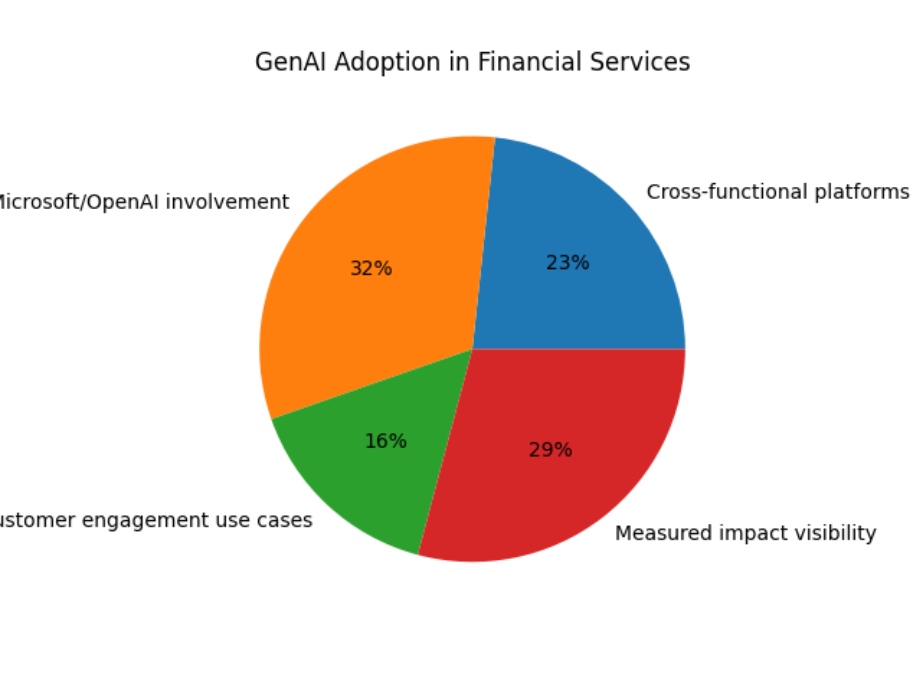
The speed of AI adoption is increasing, but without measurable outcomes. Testing bridges the gap and converts AI adoption into a measurable business impact. If there are high adaption rates along with low visibility and uncontrolled risk, you need to take the approach of Gen AI app testing.
Why Traditional Testing Falls Short to AI Adoption?
Traditional Quality Assurance works for deterministic systems. On the other hand, QA with Artificial Intelligence has a different approach.
You now need to validate the following components:
- Variabilities in Outputs
- Prompt Sensitivity
- Drift in Context
- Bias and Fairness
Without conducting QE for Gen AI apps, you cannot detect the risks until the production stage.
Ensuring Compliance and Data Integrity with Gen AI App Quality Engineering
Financial systems operate under strict regulatory requirements. AI also increases the percentage of complexity. It faces a few key challenges including data confidentiality risks, regulatory unpredictability, and lack of explainability in AI decisions.
How Gen AI app testing Solves It
Gen AI app quality engineering has its own approach of structured validation:
- Data profiling and schema validation
- Bias and anomaly detection
- Secure API and access control testing
With validated data and governed AI outputs, you can reduce compliance risks and improve audit readiness.
Scaling AI Requires Robust Gen AI Infused App Testing
Banking systems rely on various factors including APIs, microservices, and legacy platforms. AI makes it more complex. It slows you down. To avoid the lethargy, you must verify ML pipelines, orchestration amongst multiple services, and decisions taken in real time.
There are few risks if you scale without AI infused testing such as integration failures, latency issues, and regression defects.
Enhancing Experiences of the Customer While Managing AI Risks
AI has turned into a customer-facing entity. They expect to have instant and personalized interactions. AI has powered this wish to a full-fledged experience.
Here’s how you can manage AI output risks to deliver consistent customer experience:
- If your model generates incorrect responses, you can validate the outcomes with Gen AI App Testing.
- If your GenAI model misinterprets the intent of your prompts, you can conduct testing on edge scenarios.
- If you cannot deliver consistent experiences, you should measure the consistency of your responses.
Consistent AI behavior can directly improve customer trust in your organization. When the responses users get are more accurate and reliable, they are more likely to engage with your digital channels.
Enabling Faster Time-to-Market with QE for Gen AI Apps
Early AI adopters can achieve measurable gains. It includes improved returns and faster innovation cycles.
With QE for Gen AI apps, you can automate testing workflows and integrate with CI/CD pipelines. It will lead to a continuous and consistent validation cycle.
Measurable Impact:
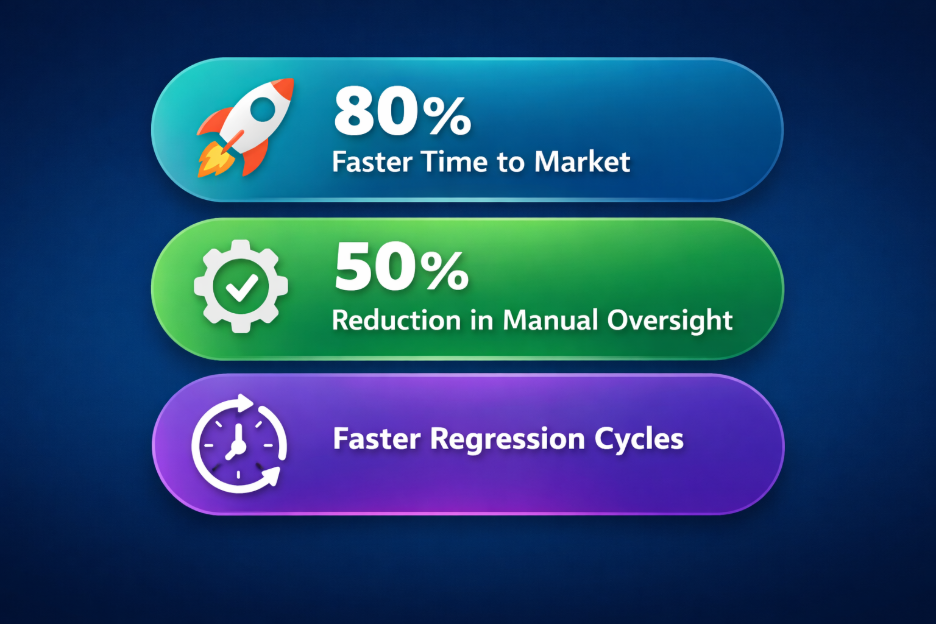
With automation and continuous testing, you will be able to achieve faster releases while keeping risks under control.
Scaling Gen AI App Testing with Accelerators and Integrated Tool Ecosystems
Following are the accelerators of TestingXperts that will scale Gen AI App testing for you.
- Tx-SmarTest: Key capability of this accelerator is bot-led testing, and it leads to faster test cycles.
- Tx-PEARS: It enhances the impact of security and performance testing and helps you to save more than 30% cost.
- Tx-ReUseKit: With this accelerator, you will get ready templates and helps you to implement setup GenAI app testing faster.
- Tx-TestMethods: It will help you with enhanced lifecycle optimization and efficiency up to 30%.
- Tx-DevOps: It will provide better visibility to your DevOps and save your time up to 25 to 30 percent.
- Tx-Botomate: It will enhance your credibility of NLP testing and lead to reliable chatbot validation.
- Tx-UiPath: It has plenty of automation frameworks and helps you create tests faster.
- Tx-Automate: It will increase your efficiency in high automation and lead to faster regression.
Conclusion
AI will define the future of banking. But without structured validation, there are more chances of risks instead of adding any measurable value.
If you integrate Gen AI app testing, and QE for Gen AI apps, your AI systems will become more reliable, compliant, and scalable. If you also want to scale AI with confidence, you need a structured validation across models, data, and integrations. Partner with TestingXperts and get assistance in implementing Gen AI app testing and QE frameworks that reduce risk, improve reliability, and accelerate your AI initiatives.