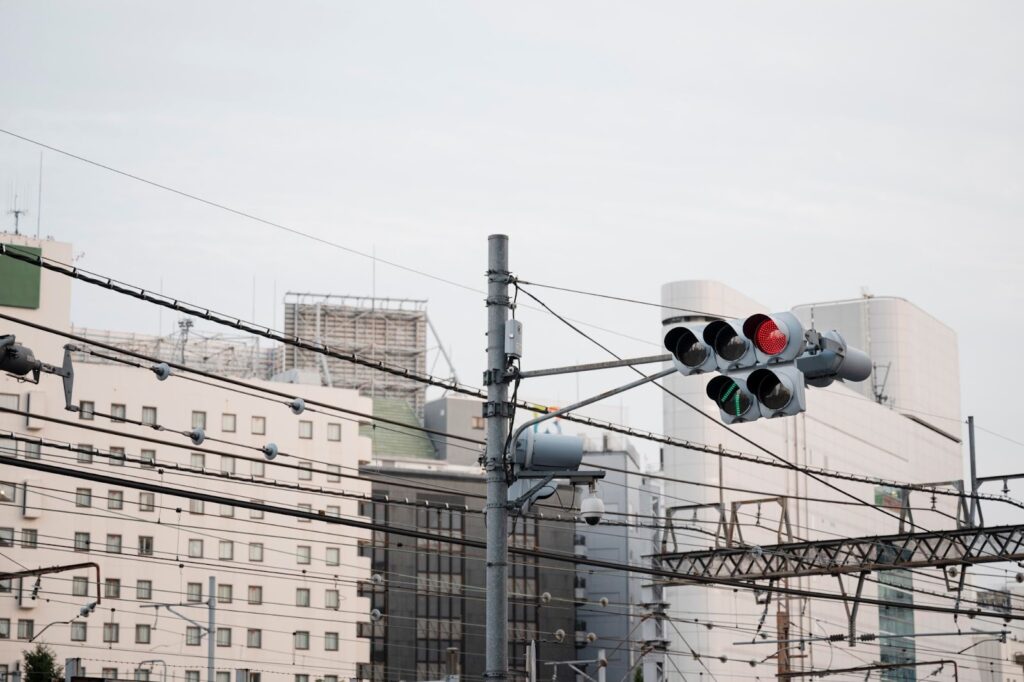
Traffic signal technology is much discussed in the context of urban safety and smart mobility. The hardware that controls signal logic, optical performance, and communications has evolved significantly over the past several decades. But one fundamental element of the system is given relatively little attention the physical structures that keep it all in place. Even the most advanced signal technology, when supported by untrustworthy, poorly designed infrastructure, will not be able to function as intended. The poles and mounting hardware used to elevate signals above roadways are not afterthoughts in the system; they are key components whose importance can be gauged by considering what the system is intended to achieve.
Evolution of Traffic Signal Support Systems
Early signal poles were utilitarian and basic, made from standard steel sections and intended only to raise a signal to a visible height with no thought given to long-term durability or environmental performance. Corrosion, wind loading, and car impact were treated reactively and not through engineering design.
As traffic systems became more complex and signal networks more essential to the functioning of cities, the engineering standards for support structures were developed in tandem. Advances in material technology have resulted in high-strength steel alloys and aluminum matrix composites having much higher strength-to-weight ratios than conventional materials.
Surface treatment processes, such as hot-dip galvanization, polyester powder coating, and multilayer corrosion protection systems, have significantly increased service lives in environments that were once considered punishing to metal infrastructure.
The mechanics of structural engineering developed with the materials. Finite element analysis is used in modern pole design to simulate the stress distribution due to wind load, dynamic vehicle vibration, and seismic loading - leading to poles that are designed to achieve certain expected performance criteria as opposed to approximate factor of safety margins.
Key Features of High-Quality Traffic Light Poles
The defining performance of high-specification signal support structures that set them apart from lower quality descriptions is unmistakable and quantifiable.
Among the most important is wind resistance. Poles at exposed urban intersections must be able to resist constant wind and gusts without deflecting to the point that it would cause (a) the traffic signals hanging on it out of position or (b) structural collapse. Meeting regional wind load standards is table stakes, not a selling feature.
Protection from rust determines the operational life in a real application. A well-designed traffic light pole has a multi-layer surface treatment to protect against rust in marine, polluted, and moist surroundings – environmental factors that speed up rust in untreated metal constructions.
Standardized height and mounting geometry help ensure that signals meet sightline specifications recommended in traffic engineering practice – by locating the signal face where it can be expected to be seen from the visual field of the approaching vehicle at distances from trigger points it can ‘effectuate safe response’.
How Strong Support Structures Improve Traffic Safety
There is a direct correlation between pole strength and traffic safety. A target that moves away from the signal path as a consequence of structural deflection, whether wind, impact from a vehicle, or the settling of the foundation, emits a misaligned optical signal to drivers on the road. Even small angular misalignments can take a signal face out of its designed visibility cone, which means that for some approaches, it would be invisible.
Maintenance frequency is a safety factor and a operation cost. A high-quality traffic light pole design to withstand years of service without compromising the quality of its material and that can support the signal geometry within acceptable limits will reduce the frequency of inspections and repairs, limiting the length of time during which the deterioration of the support structure can be considered an additional risk factor.
The long-term stability of positioning is determined by foundation design, which is discounted in evaluations of pole quality. Engineered proper base designs are based on soil types, frost line, and dynamic loads so that pole straightness is sustained throughout freeze/thaw ground movement cycles.
Conclusion
The reliability of a traffic signal system is ultimately a function of the physical infrastructure on which it rests. Durable, precision-machined support structures. Signals remain properly positioned and are capable of withstanding environmental forces while maintaining operational stability for thousands of hours of service. Considering pole specification as a secondary purchasing option diminishes its importance in traffic infrastructure, structural strength, and signal optics are one and the same.
Ai Report