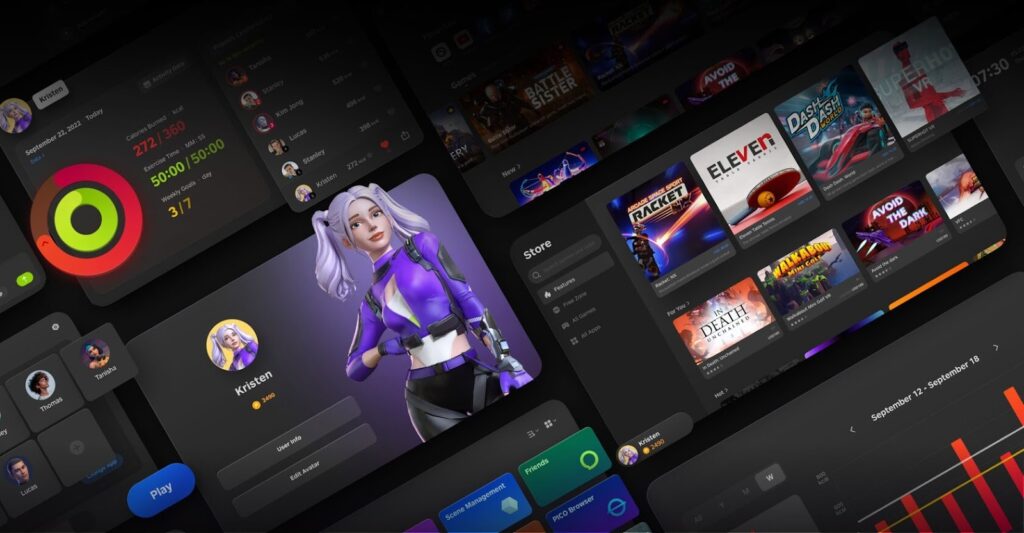
PICO has officially revealed PICO OS 6, a completely redesigned spatial operating system, while also offering an early glimpse at its upcoming premium XR device, Project Swan. Together, the announcements mark a major step in the evolution of immersive computing—pairing a rebuilt software foundation with next-generation hardware ambition.
Developers can begin working with PICO OS 6 starting March 2, using new tools to create applications optimized for Project Swan ahead of its planned global launch in late 2026.
A True Architectural Reset for Spatial Computing
PICO OS 6 is not positioned as a routine upgrade. Instead, it represents a full-scale reconstruction of the company’s spatial operating system.
Rather than layering immersive features onto traditional frameworks, PICO redesigned the architecture from the ground up to allow 2D applications, 3D content, immersive virtual environments, and real-world passthrough to operate within one cohesive system.
This shift addresses one of XR’s long-standing challenges: fragmentation between app types and environments. With OS 6, those boundaries are minimized, allowing digital and physical elements to coexist more fluidly and naturally.
The PICO Spatial Engine: Rendering Reimagined
At the core of this transformation is the PICO Spatial Engine—a new unified rendering system that moves graphics processing from the application layer to the operating system itself.
Previously, individual apps handled their own rendering pipelines, which could lead to performance inconsistencies. With OS-level rendering, the system can now process:
- Floating 2D windows
- Complex 3D applications
- Fully immersive virtual worlds
- Live mixed reality passthrough
simultaneously and efficiently.
By centralizing the rendering pipeline, PICO OS 6 enables smoother multitasking and ensures that digital objects blend seamlessly into the physical environment without noticeable lag.
Spatial Multitasking Without Mode Switching
One of the most significant upgrades in PICO OS 6 is its approach to multitasking. Instead of forcing users to switch between work and immersive modes, the system allows them to exist together in the same space.
Users can collaborate on detailed 3D models with remote teammates represented as avatars, while keeping web browsers, documents, or communication tools floating in view. This design makes spatial computing practical not only for entertainment but also for professional workflows.
The input system adapts to different scenarios, supporting:
- Look-and-pinch gesture controls
- XR controllers for immersive experiences
- Keyboard and mouse for traditional productivity
For the more than 2,600 enterprise institutions already working with PICO, this architecture provides a stable and scalable digital workspace built specifically for spatial collaboration.
An Open and Inclusive Ecosystem
PICO OS 6 embraces interoperability as a guiding principle. Instead of prioritizing one ecosystem over another, the system treats multiple frameworks as equal components.
Supported environments include:
- Spatial-native applications
- OpenXR
- WebXR
- Android apps
- Web apps
- PC VR streaming
By lowering entry barriers and unifying distinct ecosystems within one interface, PICO aims to create a development environment that is flexible and future-ready.
Tools That Accelerate Spatial Development
To complement OS 6, PICO has launched an expanded developer toolkit designed to simplify and accelerate spatial app creation.
PICO Spatial SDK (Kotlin)
The SDK introduces component-based APIs and unified runtime adaptability, enabling developers to design spatial interfaces more efficiently.
Android Studio Integration and Desktop Emulator
With the PICO Spatial Plugin and a desktop-based emulator, developers can build and test applications without requiring immediate headset access. This streamlines development cycles and reduces hardware dependency.
WebSpatial Framework
PICO is also introducing WebSpatial, an open-source framework that extends standard web technologies—HTML, CSS, and React—into spatial computing.
WebSpatial allows developers to create cross-platform, install-free spatial applications that run across PICO OS, VisionOS, and AndroidXR. This approach opens XR development to the global web community.
Unity and Unreal Engine Enhancements
Deepened integration with Unity and Unreal Engine enables mixed reality games to operate alongside floating 2D and 3D windows. Players can now game while video chatting or browsing, adding a new dimension of multitasking within immersive environments.
All development tools are available now at developer.picoxr.com.
Project Swan: The Hardware to Match the Vision
While PICO OS 6 lays the software groundwork, Project Swan is designed to provide the hardware leap necessary to unlock its full potential.
Next-Generation MicroOLED Displays
Project Swan will feature advanced MicroOLED panels with nearly 4000 pixels per inch—approximately nine times the density of today’s flagship smartphones.
The display system delivers:
- An average of 40 Pixels Per Degree (PPD)
- A center sweet spot exceeding 45 PPD
This level of clarity is designed to make text sharp enough for extended professional use, pushing spatial computing closer to replacing traditional monitors.
Dual-Chip Mixed Reality Architecture
To handle the complexity of mixed reality processing, Project Swan incorporates a dual-chip design.
- A custom XR silicon chip powers perception and imaging systems, combining multi-sensor data to reconstruct the real world with just 12 milliseconds of latency.
- A flagship system-on-chip delivers more than double the CPU and GPU performance compared to XR2 Gen 2.
This combination aims to deliver low-latency, high-performance immersive experiences while maintaining system responsiveness.
Project Swan is currently targeted for global release in late 2026.
Global Early Access Program
To ensure strong alignment between OS and hardware before launch, PICO has introduced the PICO Global Early Access Program.
The closed beta initiative invites experienced XR users—particularly those familiar with premium devices—to test PICO OS 6 and Project Swan. The program is designed to gather technical feedback and refine the platform ahead of its official debut.
Applications are now open via picoxr.com.
A Strategic Move Toward Unified Spatial Computing
With PICO OS 6 and Project Swan, PICO is signaling a long-term commitment to reshaping spatial computing.
By rebuilding its operating system architecture, centralizing rendering at the OS level, embracing open development frameworks, and pairing it with next-generation display and processing technologies, PICO is laying the foundation for a more integrated XR future.
As immersive technology matures, PICO’s latest announcements suggest a shift from isolated experiences toward a unified computing model—where work, collaboration, entertainment, and physical reality coexist within one seamless spatial environment.