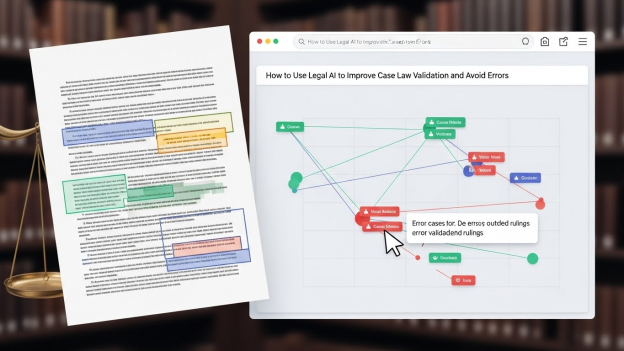
Case law validation is one of the most critical—and risky—parts of legal research. Relying on an overruled or negatively treated case can weaken arguments, damage credibility, and even lead to sanctions. Yet, under time pressure and growing caseloads, validating every citation manually is increasingly difficult.
This is where Legal AI is changing the game. By combining artificial intelligence with legal expertise, Legal AI tools help lawyers validate case law faster, more accurately, and with greater confidence, significantly reducing the risk of costly errors.
This article explains how Legal AI improves case law validation, common pitfalls in traditional research, and best practices for using Legal AI responsibly.
What Is Case Law Validation?
Case law validation often called checking good law is the process of confirming that a judicial decision:
- Is still valid
- Has not been overruled, reversed, or limited
- Is cited appropriately for the legal proposition relied upon
It ensures that legal arguments are based on current and authoritative law.
Why Case Law Validation Is So Important
Courts expect attorneys to cite accurate and current authority. Failure to do so can result in:
- Judicial criticism
- Weakened arguments
- Ethical violations
- Loss of client trust
Inaccurate citations can undermine even well-reasoned legal positions.
Traditional Case Law Validation: Challenges and Risks
Traditional validation methods rely on:
- Manual citation checking
- Separate validation tools
- Time-intensive cross-referencing
Common Risks
- Missing negative treatment
- Overlooking recent decisions
- Misinterpreting how a case was distinguished
As legal databases grow, these risks increase.
What Is Legal AI Case Law Validation?
Legal AI case law validation uses artificial intelligence to:
- Analyze how cases are cited across decisions
- Identify negative, positive, or neutral treatment
- Track changes in legal authority over time
Legal AI systems automate much of the validation process while keeping lawyers in control.
How Legal AI Improves Case Law Validation
1. Automated Citation Analysis
Legal AI scans thousands of cases to:
- Track citation frequency
- Identify overruling or limiting decisions
- Highlight judicial criticism
This reduces the risk of missing critical authority.
2. Contextual Understanding of Case Treatment
Unlike basic tools, Legal AI evaluates how a case is cited:
- Followed
- Distinguished
- Questioned
- Overruled
Contextual analysis ensures accurate interpretation.
3. Real-Time Updates
Legal AI platforms continuously update case treatment data, helping lawyers rely on the most current law available.
4. Jurisdiction-Specific Validation
Legal AI respects jurisdictional hierarchy, ensuring that validation reflects binding and persuasive authority accurately.
5. Integration with Legal Research and Drafting
Legal AI links validation directly to research and drafting workflows, reducing context switching and improving efficiency.
Step-by-Step: Using Legal AI for Case Law Validation
Step 1: Conduct Initial Legal Research
Use Legal AI to identify relevant cases based on legal issues, jurisdiction, and procedural posture.
Step 2: Trigger Automated Validation
Once a case is selected, Legal AI automatically checks:
- Subsequent citation history
- Treatment by higher courts
- Recent developments
Step 3: Review Treatment Indicators
Legal AI presents visual indicators or summaries showing:
- Positive treatment
- Negative treatment
- Mixed treatment
Always review underlying citations for confirmation.
Step 4: Drill Down into Critical Citations
Click through to:
- Overruling decisions
- Distinguishing cases
- Limiting opinions
This helps refine arguments.
Step 5: Confirm Jurisdictional Relevance
Ensure the case remains valid and authoritative in your jurisdiction.
Step 6: Apply Human Judgment
Even with Legal AI, lawyers must:
- Interpret legal significance
- Decide strategic value
- Contextualize authority
How Legal AI Helps Avoid Common Validation Errors
Error 1: Citing Overruled Law
Legal AI flags overruled or reversed cases immediately.
Error 2: Missing Negative Treatment
Automated scanning reduces oversight risk.
Error 3: Misusing Persuasive Authority
Legal AI clarifies jurisdictional weight.
Error 4: Outdated Research
Continuous updates ensure current authority.
Benefits of Legal AI in Case Law Validation
Speed
Validate cases in seconds.
Accuracy
Reduce citation-related errors.
Confidence
Submit filings with greater assurance.
Efficiency
Spend more time on strategy, less on manual checking.
Legal AI vs Manual Validation
| Aspect | Manual Validation | Legal AI Validation |
| Speed | Slow | Fast |
| Coverage | Limited | Comprehensive |
| Error Risk | Higher | Lower |
| Scalability | Low | High |
Best results come from combining both.
Ethical Considerations and Best Practices
- Always verify AI outputs
- Maintain professional accountability
- Use trusted Legal AI platforms
- Stay informed on ethical guidance
- Document validation steps when necessary
The Future of Legal AI in Case Law Validation
Legal AI will continue evolving with:
- Better explainability
- Deeper context awareness
- Predictive legal analysis
- Improved transparency
Case law validation will become faster, smarter, and more reliable.
Final Thoughts
Case law validation is too important to leave to chance. Legal AI provides powerful tools to improve accuracy, reduce risk, and avoid costly errors—but only when used responsibly.
By combining Legal AI’s automation with human legal judgment, lawyers can ensure their arguments rest on solid, current authority—strengthening credibility in court and protecting clients’ interests.
Legal AI doesn’t replace careful lawyering.
It reinforces it.