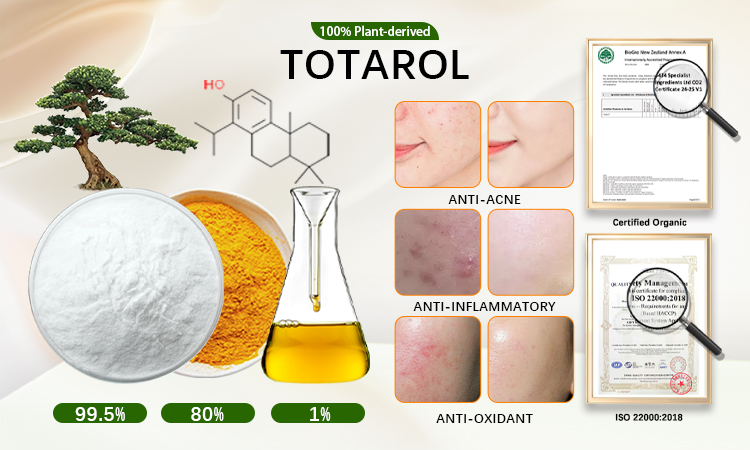
Totarol and Resveratrol are two potent natural compounds, each derived from distinct botanical sources, yet both exhibiting remarkable biological activities that are highly valuable in health, medicine, and cosmetology. Totarol is a phenolic diterpene primarily isolated from the heartwood of the Tōtara tree (Podocarpus totara), a majestic tree native to New Zealand, renowned for its wood’s extraordinary resistance to decay. Resveratrol, on the other hand, is a polyphenolic phytoalexin belonging to the stilbene class, famously found in the skin of red grapes, berries, and Japanese knotweed (Polygonum cuspidatum).
Despite their structural differences—Totarol being a complex, three-ringed diterpenoid, and Resveratrol being a relatively simpler stilbenoid—their mechanisms of action frequently overlap, particularly in their capacity as antioxidants and their impact on cellular defense pathways.
Resveratrol: The Longevity and Anti-Aging Polyphenol
Resveratrol ($3,4′,5$-trihydroxystilbene), typically studied in its more stable trans-isomer form, is arguably one of the most intensely researched natural molecules of the last few decades. Its widespread biological activity stems from its ability to interact with several major cellular signaling pathways, making it a powerful candidate for anti-aging and chronic disease prevention.
Molecular Mechanisms and Signaling Pathways
Resveratrol’s health benefits are fundamentally linked to its modulation of key enzymes and transcription factors:
- Sirtuin Activation: Resveratrol is a known activator of Sirtuin 1 (SIRT1), an $\text{NAD}^+$-dependent deacetylase enzyme often referred to as a “longevity gene.” SIRT1 plays a critical role in cellular stress resistance, DNA repair, and energy metabolism. By activating SIRT1, Resveratrol helps mimic the effects of caloric restriction, a dietary intervention linked to extended lifespan in various organisms.
- Antioxidant Defense (Nrf2): It influences the Nuclear Factor Erythroid 2-Related Factor 2 (Nrf2) pathway. Nrf2 is a master regulator of the antioxidant response, and its activation by Resveratrol leads to the upregulation of endogenous antioxidant enzymes, such as superoxide dismutase (SOD) and catalase.
- Anti-inflammatory Effects: Resveratrol suppresses the activation of Nuclear Factor $\kappa$B ($\text{NF-}\kappa\text{B}$), a primary regulator of inflammatory responses. By inhibiting $\text{NF-}\kappa\text{B}$ and reducing the expression of pro-inflammatory cytokines (e.g., IL-6, TNF-$\alpha$), it exerts a significant anti-inflammatory effect.
Clinical and Cosmeceutical Applications
- Cardioprotection: By promoting the production of nitric oxide (NO), Resveratrol helps blood vessels relax, potentially lowering blood pressure and improving overall cardiovascular function. It also exhibits anti-platelet aggregation properties.
- Skin Photo-protection and Anti-aging: Topically, Resveratrol is a vital ingredient in advanced skincare. Its potent antioxidant activity effectively neutralizes Reactive Oxygen Species (ROS) generated by UV radiation and environmental pollution, thus preventing photo-aging and damage to collagen and elastin fibers. It also helps soothe redness and irritation due to its anti-inflammatory action.
- Metabolic Health: Through its modulation of AMP-activated protein kinase (AMPK) and SIRT1, Resveratrol shows potential in regulating glucose and lipid metabolism, offering benefits for conditions like type 2 diabetes and obesity.
Totarol: The Potent Antimicrobial Diterpene
Totarol, a diterpene with a phenolic structure, has historically been appreciated for its role in making the Tōtara wood highly resistant to decay, a clue to its powerful antimicrobial activity.
Selective Antimicrobial Activity
Totarol’s most distinctive and commercially recognized property is its potent activity against certain strains of bacteria and fungi:
- Targeting Gram-Positive Bacteria: It exhibits strong, often bactericidal, activity primarily against Gram-positive bacteria, including highly problematic strains like Methicillin-Resistant Staphylococcus aureus (MRSA) and Propionibacterium acnes (a major contributor to acne).
- Mechanism of Action: The exact mechanism is multi-faceted, but studies suggest Totarol works by:
- Disrupting Cell Membrane Integrity: The lipophilic nature of Totarol’s diterpene structure, combined with its phenolic group, allows it to embed itself in the bacterial cell membrane, thereby increasing permeability, leading to the leakage of essential cellular materials, and inhibiting ATP synthesis.
- Efflux Pump Inhibition: Totarol has been shown to act as an efflux pump inhibitor (EPI), especially against the NorA efflux pump in Staphylococcus aureus. Efflux pumps are a primary mechanism by which bacteria develop multi-drug resistance (MDR), meaning Totarol can potentially re-sensitize resistant bacteria to conventional antibiotics, creating a powerful synergistic effect.
Antioxidant and Cosmetic Applications
While its primary utility is antimicrobial, Totarol is also a powerful antioxidant:
- ROS Scavenging: Research indicates that Totarol is a highly effective scavenger of ROS and strong inhibitor of lipid peroxidation, sometimes cited as being multiple times more effective than Vitamin E. This makes it a valuable preservative booster in formulations.
- Acne Treatment: Due to its targeted activity against $P$. acnes and its anti-inflammatory properties, Totarol is increasingly used in topical cosmetic formulations aimed at preventing and treating acne and blemishes.
🤝 Synergy in Skincare and Cellular Defense
The combination of Totarol and Resveratrol presents a compelling and multifunctional approach, particularly in the realm of advanced skincare and general health defense:
Feature Totarol Resveratrol Synergy Primary Action Potent Antimicrobial (Gram-positive) Systemic Anti-aging (SIRT1 activation) Broad-spectrum cellular defense. Antioxidant Power Extremely strong ROS Scavenger, Anti-lipid peroxidation Potent Free Radical Neutralizer, Nrf2 activation Comprehensive protection against oxidative stress and photo-damage. Inflammation Control Moderate, related to bacterial suppression Strong, through $\text{NF-}\kappa\text{B}$ inhibition Multi-pathway control of redness and irritation. Skincare Benefit Targeted acne-causing bacteria control, preservation Photo-protection, anti-wrinkle, collagen support A complete solution for acne-prone, aging, and environmentally stressed skin.
A Holistic Skin Health Strategy
For topical use, the synergy is exceptionally valuable:
- Addressing Acne Holistically: Totarol directly targets the bacterial component of acne (P. acnes), while Resveratrol addresses the resulting inflammation and aids in skin repair and defense against oxidative damage that can exacerbate the condition and lead to scarring.
- Enhanced Preservation: Totarol’s powerful antimicrobial properties make it an effective natural preservative or preservative booster in formulations. This protects the product itself and allows the highly sensitive Resveratrol to maintain its stability and effectiveness, ensuring the consumer receives the full benefit of both actives.
- Comprehensive Anti-Aging: Resveratrol provides the cellular longevity and collagen-boosting signals needed for long-term anti-aging, while Totarol contributes powerful primary antioxidant defense, protecting the skin’s structural proteins from premature degradation caused by free radicals.
In essence, Totarol acts as a targeted natural biocide and powerful defensive antioxidant, while Resveratrol operates as a sophisticated cell signaling modulator and systemic antioxidant. Together, they create a robust and versatile biological shield, illustrating the immense potential of combining natural bioactives for enhanced therapeutic effect.