The agricultural industry has witnessed tremendous growth in recent years, driven by the increasing demand for high-quality crops. Fertilizers play a crucial role in maintaining soil fertility and ensuring optimal crop yields. Among various fertilizers, NPK fertilizers — which contain nitrogen (N), phosphorus (P), and potassium (K) — are widely recognized for their balanced nutrient composition that supports plant growth and productivity. To meet the growing demand, many agricultural enterprises are investing in advanced fertilizer production equipment. Two prominent solutions in this field are the NPK compound fertilizer granulation production line and the large-scale NPK fertilizer production line. Understanding the features, advantages, and applications of these production lines can help businesses make informed decisions.
What is an NPK Compound Fertilizer Granulation Production Line?
An NPK compound fertilizer granulation production line is a set of machinery designed to produce compound fertilizers in granule form. Unlike single-nutrient fertilizers, NPK fertilizers provide a combination of nitrogen, phosphorus, and potassium, which are essential for balanced plant nutrition. This production line employs advanced granulation technology to convert raw materials into uniform granules suitable for storage, transportation, and direct application to fields.
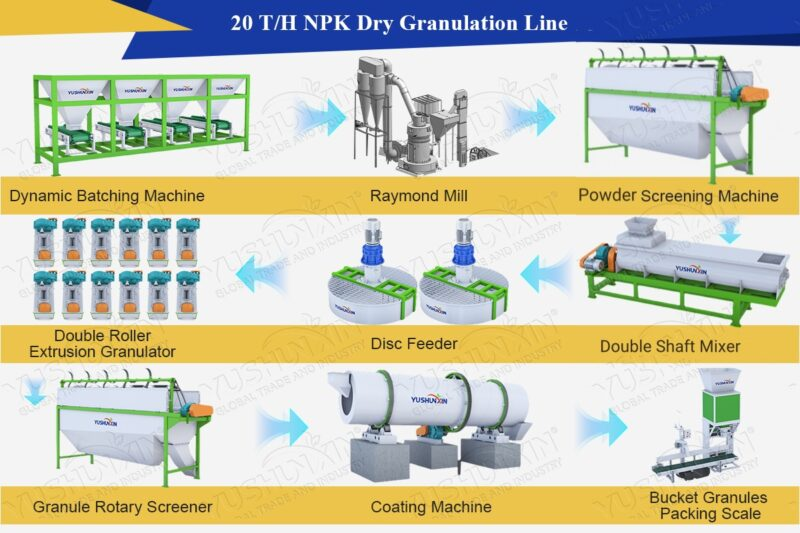
The production line generally includes several key components:
- Batching and Mixing System – Accurately measures raw materials and blends them to achieve the desired nutrient ratio.
- Granulator – Converts powdered raw materials into granules using either extrusion or roller compaction methods.
- Dryer and Cooler – Removes excess moisture from the granules to prevent caking and ensure durability.
- Screening Equipment – Separates granules by size to maintain uniformity.
- Coating Machine – Adds protective layers to granules to enhance storage stability.
- Packaging System – Automates the process of bagging and labeling the final product for shipment.
The NPK compound fertilizer granulation production line is designed for medium to large-scale operations, offering high efficiency, low energy consumption, and excellent granule quality. Its versatility allows producers to manufacture NPK fertilizers in various ratios, catering to different crops and soil types.
Advantages of an NPK Compound Fertilizer Granulation Production Line
Investing in an NPK compound fertilizer granulation production line offers several significant advantages for fertilizer manufacturers:
- High Granulation Rate – Modern granulators produce uniform granules with a high success rate, reducing material waste.
- Customizable Nutrient Ratios – Manufacturers can adjust the proportions of nitrogen, phosphorus, and potassium to meet specific crop requirements.
- Enhanced Fertilizer Efficiency – Granular fertilizers release nutrients slowly and steadily, improving soil absorption and reducing nutrient loss.
- Reduced Labor Costs – Automation in mixing, granulating, drying, and packaging minimizes manual labor.
- Environmental Benefits – Properly designed production lines reduce dust, emissions, and runoff, promoting eco-friendly fertilizer manufacturing.
By using this production line, agricultural enterprises can ensure consistent product quality, improve operational efficiency, and increase profitability.
Large-Scale NPK Fertilizer Production Line
For businesses aiming for industrial-level fertilizer output, a large-scale NPK fertilizer production line is an ideal choice. This production line is capable of producing significantly higher quantities of granulated fertilizers, often exceeding 20 tons per hour, making it suitable for large commercial farms and fertilizer manufacturers.
The large-scale NPK fertilizer production line often uses dry granulation technology, which reduces water consumption and accelerates production speed. This method involves compressing powdered raw materials into granules using roller extrusion machines. The granules are then screened, cooled, coated, and packaged efficiently.
Key features of a large-scale NPK fertilizer production line include:
- High Production Capacity – Capable of meeting the demands of industrial-scale agricultural operations.
- Continuous Operation – Designed for uninterrupted processing to maximize output.
- Energy Efficiency – Optimized machinery minimizes electricity and fuel consumption.
- Durable Equipment – Heavy-duty granulators, dryers, and coolers ensure long-term reliability.
Benefits of a Large-Scale NPK Fertilizer Production Line
Investing in a large-scale NPK fertilizer production line brings multiple benefits:
- Increased Production Volume – High throughput allows manufacturers to supply large agricultural markets consistently.
- Lower Per-Unit Costs – Economies of scale reduce production costs per ton, improving profit margins.
- Consistent Product Quality – Advanced granulation and screening systems ensure uniform granule size and nutrient distribution.
- Flexible Operations – Can produce a wide range of NPK formulations to meet varying market demands.
- Integration with Automation Systems – Reduces manual intervention, minimizes human error, and streamlines logistics.
By adopting a large-scale production line, companies can not only meet market demands efficiently but also expand their product portfolio to include specialty fertilizers for different crops.
Choosing Between Medium-Scale and Large-Scale Production Lines
The choice between an NPK compound fertilizer granulation production line and a large-scale NPK fertilizer production line depends on several factors:
- Production Requirements – Medium-scale lines are suitable for regional markets, while large-scale lines are ideal for national or international supply.
- Budget Constraints – Large-scale production lines require higher initial investment but offer greater returns in the long run.
- Available Space – Large-scale operations demand more facility space for equipment and storage.
- Operational Expertise – Industrial-scale lines often require skilled technicians to manage continuous operations efficiently.
Businesses should evaluate their production goals, market reach, and financial capacity before selecting the appropriate line.
Applications of NPK Fertilizer Production Lines
Both NPK compound fertilizer granulation production lines and large-scale NPK fertilizer production lines have wide-ranging applications in the agricultural sector:
- Commercial Fertilizer Production – Supplies granulated fertilizers to wholesalers, retailers, and farmers.
- Custom Fertilizer Formulation – Produces specialized blends tailored to specific crops, soil conditions, or growth stages.
- Organic and Eco-Friendly Fertilizers – Some lines can process organic raw materials, promoting sustainable agriculture.
- Export Markets – High-quality granules produced by these lines meet international standards for export.
The flexibility and scalability of these production lines make them an indispensable asset for modern fertilizer manufacturers.
Conclusion
The global demand for high-quality NPK fertilizers continues to rise, creating opportunities for businesses to expand their fertilizer production capabilities. Investing in an NPK compound fertilizer granulation production line or a large-scale NPK fertilizer production line ensures that manufacturers can produce uniform, nutrient-rich granules efficiently and economically.
While medium-scale granulation lines are perfect for regional production and custom fertilizer formulations, large-scale production lines cater to industrial-level operations with high throughput and automation. Both solutions offer improved operational efficiency, consistent product quality, and environmental benefits, making them ideal choices for businesses looking to thrive in the competitive agricultural sector.
Ultimately, selecting the right production line depends on your specific production goals, market demands, and operational capacity. By leveraging advanced granulation technologies, agricultural enterprises can meet the growing need for balanced fertilizers, support sustainable farming practices, and achieve long-term profitability.