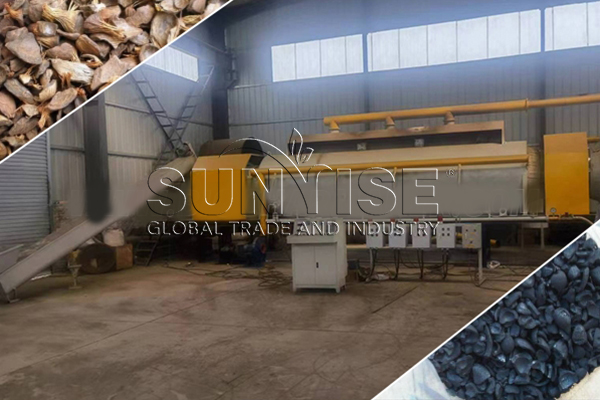
Charcoal remains an essential energy source in many industries, ranging from domestic cooking to industrial fuel production. Among the various types of biomass used for charcoal, palm kernel shells have gained prominence due to their high carbon content, renewable nature, and availability as a byproduct from palm oil production. Modern charcoal production relies on specialized machinery to maximize output, efficiency, and quality. Two key systems dominate the market: the palm kernel shell charcoal machine and large-scale continuous furnaces. Understanding their features, benefits, and applications is crucial for entrepreneurs and businesses aiming to establish or expand their charcoal production operations.
Palm Kernel Shell Charcoal Machine: Transforming Waste into Value
The palm kernel shell charcoal machine is designed specifically to convert palm kernel shells into high-quality charcoal. This equipment utilizes pyrolysis technology, a process in which organic material is heated in a low-oxygen environment, causing thermal decomposition without combustion. The result is pure carbon, with minimal ash and excellent energy content.
Key Features:
- Integrated System: Most palm kernel shell charcoal machines combine several components, including a material pretreatment unit, pyrolysis reactor, and charcoal briquetting machine. This integration ensures smooth production flow, reduces manual labor, and enhances overall efficiency.
- Energy Efficiency: The pyrolysis process in these machines often recycles volatile gases released during carbonization, using them as fuel for heating the reactor. This feature significantly reduces energy consumption and operational costs.
- Flexibility: Although optimized for palm kernel shells, many models can process other biomass materials like coconut shells, wood chips, and sawdust, making them versatile for small to medium-scale operations.
- Environmental Benefits: By converting palm kernel shells—a common agricultural waste—into charcoal, these machines reduce environmental pollution and promote sustainable waste management.
Applications:
- Domestic charcoal production for cooking and heating.
- Industrial fuel for brick kilns, foundries, and steel industries.
- Production of activated carbon for water treatment and filtration systems.
The palm kernel shell charcoal machine is ideal for businesses that aim to focus on palm-based biomass, especially in regions where palm oil production generates significant shell waste. It is cost-effective, relatively easy to operate, and suitable for medium-scale production, making it a popular choice for entrepreneurs entering the charcoal industry.
Large-Scale Continuous Furnaces: High-Capacity Charcoal Production
For enterprises targeting high-volume charcoal output, large-scale continuous furnaces are the industry standard. Unlike batch-type furnaces, continuous systems operate non-stop, converting biomass into charcoal without interruption. This approach ensures consistent quality, higher production rates, and lower labor requirements.
Key Features:
- Continuous Operation: Large-scale continuous furnaces are designed for 24/7 operation. Biomass is automatically fed into the furnace, undergoes carbonization, and exits as finished charcoal, all in a streamlined process.
- Automation: Advanced control systems manage temperature, feeding speed, and gas collection, reducing human intervention and minimizing operational errors.
- High Capacity: These furnaces can handle several tons of biomass per hour, making them suitable for industrial-scale production. Their capacity often ranges from 5 to 30 tons per hour, depending on the model and design.
- Versatility: While optimized for palm kernel shells, large-scale continuous furnaces can process a variety of biomass materials, including wood chips, sawdust, coconut shells, and agricultural residues.
- Energy Recovery: Similar to palm kernel shell charcoal machines, continuous furnaces utilize pyrolysis gases to fuel the carbonization process, enhancing energy efficiency and reducing operational costs.
Applications:
- Industrial charcoal production for energy-intensive processes such as metallurgy, power generation, and cement manufacturing.
- Production of uniform, high-quality charcoal for export markets.
- Integration into large-scale activated carbon production systems.
The main advantage of large-scale continuous furnaces is their ability to maintain consistent production levels without the downtime associated with batch systems. This makes them a preferred option for businesses aiming to meet high market demand and ensure reliable product quality.
Comparing Palm Kernel Shell Charcoal Machines and Large-Scale Continuous Furnaces
| Feature | Palm Kernel Shell Charcoal Machine | Large-Scale Continuous Furnaces |
| Production Scale | Small to medium | Large-scale industrial |
| Automation | Semi-automated | Fully automated |
| Flexibility | Primarily palm shells, some biomass | Multiple biomass types |
| Energy Efficiency | Moderate to high | High, with continuous gas recovery |
| Investment Cost | Lower, affordable for startups | Higher, requires significant capital |
| Maintenance | Easier, less complex | More technical, requires trained staff |
| Output Quality | High-quality charcoal | Consistently uniform, industrial-grade charcoal |
Choosing between these two systems depends largely on business goals, production volume, and investment capacity. For entrepreneurs entering the market or focusing on palm kernel shell utilization, a palm kernel shell charcoal machine offers a cost-effective and efficient solution. For established businesses or industrial enterprises requiring massive output, large-scale continuous furnaces provide unparalleled production capacity and operational efficiency.
Sustainability and Economic Considerations
Both technologies contribute significantly to sustainable biomass utilization. The palm kernel shell charcoal machine reduces agricultural waste and offers an eco-friendly alternative to wood-based charcoal. Meanwhile, large-scale continuous furnaces allow industrial-scale production while minimizing emissions and energy wastage through automated gas recovery systems.
From an economic perspective, investing in efficient charcoal machinery can yield substantial returns. Palm kernel shells are often available at low cost or even as free byproducts in palm oil-producing regions, making raw material expenses minimal. The high calorific value of the charcoal produced ensures that it meets market demands for both domestic and industrial applications.
Conclusion
In the modern charcoal industry, efficiency, sustainability, and quality are key factors for success. The palm kernel shell charcoal machine is ideal for small to medium-scale operations, focusing on palm shell conversion with lower investment and moderate automation. On the other hand, large-scale continuous furnaces serve industrial-scale operations, offering high capacity, automation, and versatility in biomass processing.
By selecting the appropriate technology based on production needs, entrepreneurs and businesses can not only maximize output and profitability but also contribute to sustainable resource management and environmental protection. Investing in either of these systems represents a strategic step toward building a modern, efficient, and eco-conscious charcoal production enterprise.